Facebook!

Twitter

Tumblr


Showing posts with label WINE TRENDS. Show all posts

20080109

New sensations for '08: Dinner wine marketed as a doppelganger to dinner music

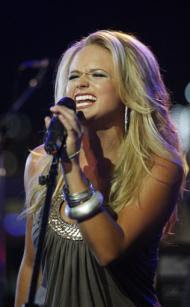
miranda lambert wine gunpowder and lead Greyhound Bound for Nowhere Famous in a Small Town desperationI noticed this news story announcing a new line of American wine because I was posting on the Top Ten tracks of 2007, not because of my Annual Best Of wine list. But I guess that's exactly the syngergy that the marketer wanted for these Merlots and Cabernets named after country singer Miranda Lambert's hit songs: Rockers, for the first time, start hunting down that particular must-have cuvée, and the winebloggers turn to give Ms. Lambert a listen for insight into what makes a wine a wine.

Read the press release, with the great hook "How about a sip of Kerosene?"

It doesn't seem like anything new and the Miranda Lambert website features the typical marketing writing that bridges winemaking and songwriting.

A good deal of time went into developing this private wine label for Miranda Lambert. The reason is simple: We believe in families working hard together and celebrating success together when it finally comes. Just like wine, in the music industry, there are no overnight sensations. Many years of hard work go into the product that the public ultimately experiences. For that reason we have partnered with the family of the LouViney Vineyards to bottle a wine worthy to put Miranda’s name on. This family owned vineyard exemplifies the very values that we honor. With each of the six wines we offer on Miranda’s private label, we trust you will taste and experience the time, effort and love that goes into every bottle. It is also our hope that you will experience the great pride that comes from working hard and celebrating success together in your own family. Thank you for enjoying a bit of ours with us.

Miranda Lambert Texas Table Wine "Red 55" Cabernet Sauvignon/Merlot

Wineries have found Cabernet Sauvignon and Merlot blends are star performers, and perhaps that’s why our friends and family selected this wine as the front-runner in our inaugural tasting. Named after Miranda’s prized first pickup, a candy apple red 1955 Chevy step-side, this beautiful cherry-colored wine is smooth and medium bodied with a mellow berry aroma. This slightly juicy blend dodges over-oaking. Just like Miranda’s vintage ‘55, our Red 55 is sure to be a classic. Pair this best-all-around wine with almost any kind of food, from fancy fare dinners to picnics and BBQs.
And if after all that you're wondering what my "top tracks" of 2007, I've posted them to my other, mostly defunct blog. Unlike the wines on Weingolb, I posted these tracks not having finished my notes for a proper review of them, but should modern rock and music criticism be your bag, stay un-tuned, as they say.

20071123

What bottle of wine backs up your meal?


How many people have asked the question: What wine do I serve with dinner? The photo above always comes to my mind when I hear this question. In fact, I should mount this photo onto a flash card and hand it out to anyone who asks. That's because it so perfectly demonstrates the answer to the question (and also because this photo literally depicts a wine bottle hidden behind the food -- you can only see the bottle neck peeking out).

So what bottle of wine backs up this meal? What wine is behind the dish? In order to answer, you've first got to determine what it is you're eating.

Well, that's easy. It's grilled salmon.


Fish = white wine. Problem solved. Push aside the red wine. Let's eat.

But wait! It's not actually fish -- that's really a chicken breast.


So slide the red wine over back over. Roasted chicken = red wine. Dig in!

And suddenly, the gustatory experience of your dinner has been reduced to easy visuals rather than tastebuds and mouthfeel. Any black-and-white answer to the pairing wine with dinner question becomes, at best, a dubious conclusion. My flash card has no clear answer written on the back. Because grilled salmon goes with red wine and white wine; roasted chicken goes with red wine and white wine.

KILLING THIS NEW WINE TREND BEFORE IT IS BORN

Around Halloweentime, Dr. Debs at Good Wine Under $20 spoke out, unearthing a spooky post. Very spooky!

In it, the wine bottles we typically see at our shops are talked about as if they're in perpetual disguise -- like their labels are masks and wine shoppers who come across them couldn't guess what's behind that mask until they open it, pour it out during dinner, and shockingly find [cue thunder and lightning bolts] that it doesn't complement your food!

Therefore, one proposed solution to this horror scene is a line of wines that have no labels at all, just the image of the food you should serve them with, as illustrated by the bottles above. How clever this is!

If only it worked. Dr. Debs explains the problem well. Kudos to the doctor -- check out the full post.

The way I see it, the problem is that the food you make is dressed up every night of the year, not just on Halloween, or on Thanksgiving. Surely no one prepares the same food the same way every night of year.

Take a look again at the flash-card photo of the dinner I recently made. At first, I couldn't even tell if it was chicken or fish I made that night -- mostly because my grilling preparation method with fresh herbs and bold flavours suits both chicken breast and salmon.

One ends up tasting like salmon and one ends up tasting like chicken. The accompanying flavours and textures always support a good food-friendly red wine. Personally, I think nine times out of 10, I'd reach for red wine after grilling no-matter-what, fish included. That's because the preparation supports flavours and textures that nine red out of ten would handle better than a typical white.

So yes, red wine with fish!

Now that's spooky for a lot of people. But to me, it's the truth. Spooky, but true.

But I'm not going to say that on average reds better suit grilled salmon without serving up readers a good example. Nine reds out of 10 may not totally convince you that red wine and fish match.

Stay tuned for the versatile, food-friendly wine I serve with almost anything -- that'll be the next post. I'll give you a hint: It's not Saumur-Champigny or anything remotely close to the Loire.

20071102

Wine blog and day job, Apollo and Dionysius, rhythm and melody?

Seeing the future from a bottle and the lines are increasingly blurred blurry

My experience wineblogging will occasionally assist my real job, but rarely has my day job ever directly helped out my wineblogging.

But then: this. This morning, a wine article called Music to drink wine by: Vintner insists music can change wine's flavors came right into my inbox at work.

It came to me not because of its stated relationship to wine -- not at all because of that, though in fact several of my colleagues now officially know I'm a wino. Rather, the news story came to me by virtue of it coincidentally mentioning my employer, which really has little to do with the actual story.

And thank goodness for that. Let's just sweep that association under the rug because this is either some whacked-out story about an eccentric winemaker named Clark Smith (pictured below) or the dawn of a new wine trend that's really going to make my head hurt.

Thinking about and taking tasting notes for the wine I drink usually hurts my head enough as it is. You try to keep wine appreciation honest by accurately deciphering aroma and flavour, length and weight and then food pairings come into the equation. All that is quite hard enough without factoring in and figuring out the various cerebral synapses firing that alter your perceptions when drinking. What this report suggests is that you've got to postulate whether a musical selection is going to hurt or hinder your ability to appreciate a particular wine. Well, can't my personal experience just be kept personal and leave it at that?

Not according to this. I won't even try to re-encapsulate it myself...

MUSIC TO DRINK WINE BY
A McGill study is cited in this San Francisco Chronicle article about whether wine tasting requires the same logical processing areas of the brain as listening to music. Research by Anne Blood and Robert Zatorre of McGill in 2001 showed that when subjects listen to music they enjoy, they activate pleasure centers of the brain.

"Smith's premise is that different music makes some wines taste better and others taste worse, and the great majority of tasters will agree with the "right" and "wrong" pairings regardless of their taste in wine or music. Moreover, it's not possible to record a generic "music to drink wine by" CD because a song that might make Pinot Noir taste great can make Cabernet Sauvignon taste awful. You have to pay attention to individual music and wine pairings.

He's only getting started, but he already has made some surprising, counterintuitive discoveries in an area of wine taste-testing that didn't even exist until he created it.
[Hmmm... is this last line delivered with skepticism or celebration?]

(Blood and Zatorre did not respond to a request for comment on Smith's theories.)"
I wonder why the scientists aren't rushing to comment?

I was. I commented before I even could post this entry, which offers the unique opportunity to blockquote myself:
Although Smith makes some attractive ideas salable here (many people, including myself, have likened a wine's elements to musicality), I still felt strangely uncomfortable while reading this. Uncomfortable, until I realized there was a voice of reason at the end of this article that was easy to latch onto: Kermit Lynch's. I don't think I want my brain to know about my brain, especially when I drink wine to kick back and relax!
So the question is: Are the lines that Smith has drawn blurred because of the converging forces affecting the minutiae of our lives which he then tries to scientifically explain away or are those lines just blurry because the guy has drunk himself off his rocker? I ask you.

20071023

For the wino who ever thought he might be too pretentious, someone's always got a bigger party tube

Today my wineblog got its first complimentary copy. It came to my office in a yellow padded envelope and I pulled it out on the bus that took me home tonight.

It made me happy to suddenly have a book to look at because it had been a long day with unforeseen public transit delays. And since I was supposed to be researching an unresolved wine tasting issue mentioned in my last post, I was thrilled to have this book in my fidgeting hands, a book all about wine no less.

So I open Wine & Philosophy, original essays edited by Fritz Allhoff and subtitled as a Symposium on EatingThinking and Drinking. Okay, now I get it. Cerebral. Abstract. Yesterday's Muscadet tasting notes which concluded with a "sur lie" conundrum -- a puzzle over what its presence on a bottle means and what it doesn't mean -- was clearly not going to be resolved by this book.

Nevertheless after flipping through quickly, I dive into the sturdy softcover by paging to the Muscadet reference listed in the index. It's in chapter thirteen, which as if by a stroke of bad luck, started with this sentence: "In the popular mind, wine tasting has often been thought of as a subjective, idiosyncratic experience, masquerading behind a false façade of expertise."

What? ...masquerading behind a false façade of expertise? That's ornery. But what made me stop short should have done to the copy editor. A false façade? The word façade in this sense is by its very definition "a deceptive or articifial face," so couldn't we say façades are always false?

Soon the essay had moved on to Kant and I began to glance around the bus furtively. Was anyone reading over my shoulder? Were passengers looking askance? I could picture them, students mostly, snickering at such a grandiose evaluation of the elitist and trendy pastime, one that I have a hand in -- with verbose writing to boot!

I'll concede that I panic easily and don't read (or ride buses) often. In any case, my worry of being ostracized proved entirely needless. A student in black jeans and Chuck Taylor Allstars had just sat down beside me with a Riedel Party Tube set of four wine glasses -- one of those long capped cylinders used to sell and transport fine crystal -- also stylishly swaddled in black. Exactly this if you need a picture. I'm assuming it still had the prohibitively expensive glasses inside and he hadn't re-purposed it for his architecture homework.

I think I stared too longingly at his Riedels too long and he caught me looking. All of a sudden, I was the plebe on this wine appreciation bus.

And realizing that, I went back to my book, and the writing got much, much better. I was really getting into the well-constructed arguments but then my stop was next. I flipped directly to the page with the Muscadet reference, page 218.

Because of the way a wine of a particular style registers on the palate as one proceeds through the ingesting stages, one can prescribe how one should taste the wine. For example, a white wine like a Muscadet from France's western Loire presents itself as a light crisp taste that is followed by a middle range of mineral qualities. It is a wonderful wine with shellfish because it cleanses the palate without dominating the subtle tastes of the seafood. Food and wine complement each other. To taste the wine expecting great complexity and a long evolving finish would be to misperceive the wine's functional character.
That's a juicy paragraph. It's the second from last in the essay, which is by Kevin W. Sweeney and is titled "Is There Coffee or Blackberry in My Wine?" and I promise I will finish it as well as the rest of the book so that I can it give a proper review. Soon.

But next I've got to get to the bottom of the sur lie situation.

20070928

Alcohol on the rise again in Canada

But Quebec an anomoly due to SAQ strike

italian french wine top sellers in quebec fiscal trend liquor sales canadaWe interrupt Wine Label Week for an important announcement. Canadians have been labeled as increasingly likely to drink booze and they do it more regularly and in larger amounts too. This was determined by 2005 facts and figures on drinking supplied by the government, which in most places across the country also supplies the wine!

I gleaned the following from a French-only report on Vin Québec:

Alcoholic beverage sales continue to surge in Canada, says Statistics Canada. 357 million litres of wine and other potent potatables were sold in 2005, which is 4 per cent more than 2004. Plus, in 2005, total sales were up: $4.2 billion, compared to $3.9 billion in 2004.

In Quebec, the numbers did not increase due to a six-week strike at the SAQ (Société des alcools du Québec) provincial liquor corporation.

No numbers from 2006 have been spit out by the state yet.

Between 2000 and 2005, the average Canadian (15 and older) increased their spending on alcohol by 35 per cent to reach $161 per person. In Quebec, average spending was $228 per person (which is definitely more my style).

Which leads to the juicy stuff... How much booze did we drink, strike or no strike at the liquor store? In Quebec, the average person had 17.5 litres of alcohol, which is still the most in Canada.

In British Columbia, the number of litres totaled 15.7; 14.3 in Alberta; and only 12.5 in Ontario.

OK, there's nothing more to see here... Back to your labels, winos.

20061127

What I think of "What to Drink With What You Eat"

I missed posting this on Buy Nothing Day. Now I fear I may be too late.

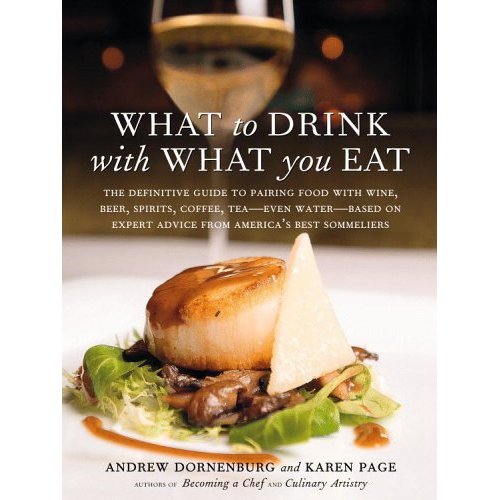
If anyone gets me the most pretentious book of the year for Christmas -- a encyclopedic dining guide called What to Drink With What You Eat by Andrew Dornenburg and Karen Page -- what to stuff in what you hang by the chimney will surely be a BIG FAT PIECE OF COAL. Why?

Well, there's the wino's angle on it and then there's the foodie's angle on it.

But first I think I need to explain something since every review I've encountered online has been balls-to-the-wall enthusiasm for this book. That I need to explain this is surprising to me because I thought what I am about to say is obvious. Here goes...

The reason folks need guidelines on pairings is precisely as follows: you've got one shot at that bottle and one shot only. You don't want to screw it up by pairing a vintage Brut Champagne with dessert. And so you turn to someone who can tell you how to get your money's worth out of it.

If you need instruction when pairing a frappuccino or some other $2 beverage from Starbucks, then clearly you're missing this point. You could dump the thing over your head and still come close to getting your money's worth. Yet this new book, WTDWWYE for short, seems to get off on recommending pairings for every drink you can think of right down to tap water. That's either silly or pretentious, or both.

If you want to pair your ciders, your juices, your bottled waters, I say go ahead. But you're kind of on your own, aren't you? I mean, there are no established guidelines for you to follow -- and there's certainly no demand to decode something so pedestrian and commonplace -- so you have to rely on your palate to guide you. But that's perfectly okay because those who follow their palate find that trial and error is a viable option for coffee, tea, water and what-have-you. (Whereas "trial and error" and Krug have never appeared in the same sentence. Ever!)
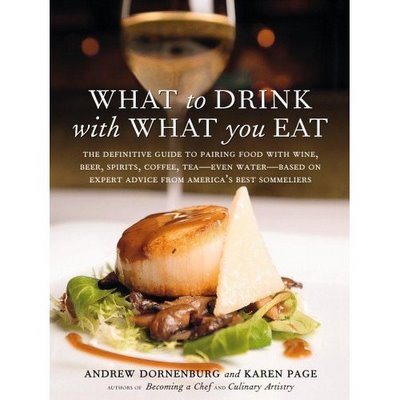
karyn paige andy dorenberg food and wine pairing bookTrial and error pairing is folly when you finally make that soufflé that doesn't sink and you really want to celebrate it in style. Like a fine wine, you've created something rare, and by god, you hope someone's been so kind to advise you how to do it justice (that Cabernet you're fingering is not the best idea -- a fate worse than falling for any soufflé). In this regard, WTDWWYE does an admirable job. It provides matches for a large array of different soufflés. It doesn't have every food under the sun -- no merguez or lamb sausage for instance -- but at least it scrapes by with entries like "Moroccan cuisine".

But that's pretty much where the instructiveness of food matching ends. Telling someone to have Evian with their veal meatballs isn't instructive as much as it's annoying. Telling someone to open a bottle for their fast-food taco is just bizarre.

In this way, WTDWWYE's approach of "we must achieve more than the sum of the parts" to every pairing gets ridiculous real fast. The catchphrase they use is 1 + 1 = 3 but no matter how often it's repeated to me it meets resistance. I think McDonald's Big Mac + any wine in the world = nothing more than a -5, not a +3 as the authors suggest. But Big Mac lovers will disagree with me. Perhaps they should buy this book.

Fast food mentions aside, WTDWWYE does deal with a lot of real food and a lot of wine. It comes at each separately: at the front, food entries are given a list of matching drinks, all supplied by culinary experts, after which beverages get their expert-generated list of pairable foods.

THE WINO'S ANGLE

Here is where the wines that readers like me have been husbanding for that special moment of culinary bliss come to the fore. I turn to Andrew and Karen and ask for advice. In response, I get a mixed bag of interesting tidbits. Personally, I find there to be too many vagaries and the stringing out of list upon list, all of them dancing around the attractive idea of finding common rules for the book's pseudo-science.

The authors get real close to securing some of these common rules at the start of the wine-based section. The clever bits contained under "By Type of Wine" is very interesting and infinitely useful. It spells out the truest and most scientific guidelines for wine matching and arranges ideas by attribute, i.e. acidic wines, tannic wines, etc. But it's only three pages and barely scratches the surface. Then the bigger 75-page "By Name of Beverage" segment begins which is only as successful as it is misguided.

What really bothers me is this guide claims to be a "definitive" source on pairings. Definitive is a big word for such a tenuous science and such a relatively small reference book. There's certainly nothing definitive about wine pairings when entries are grouped by varietal, as they are here. The authors of this book have heard of terroir and as a result some wine regions -- mostly French and broad -- are covered. Occasionally an effort is made to specify California Cabernet and Merlots. The cynic in me suspects that this only serves to better placate their key demographic.

Me, I don't drink much American wine so I first tried looking up what I had already opened from the previous night: A Minervois. There was no listing for it.

Then I tried looking for what I had on hand and was ready to drink: Coteaux du Languedoc. No listing. Not even a mention for any Languedoc wine, perhaps the biggest up-and-coming wine region in the world.

Then I dialed it back a bit and went flipping through the pages for a varietal wine. Though virtually all of my wine cellar makes no mention of grape variety as Old World wines seldom do, a knowledgeable drinker could figure it out. But that's a high-maintenance condition to using WTDWWYE. I just pretended I had a Viognier to crack open, since I recently had one that I really enjoyed. Under Viognier, the first item listed was appetizer. This is less than instructive. Mini-quiche? Pig in a blanket? Breaded shrimp? Cheeseball? What!?

The rest of the list painted a better picture for pairing Viognier. But I have to wonder about what the expert who submitted this particular response was thinking. Either the expert had more to say and the authors left it unsaid (which unfortunately is by design since all the expert-supplied entries are in strict list format) or the expert is masking his or her expertise by being imprecise. In either case, what good do the authors think these vague entries are doing?

Then I moved away from wine and investigated some of the oddities in the previous section organized by food item.

THE FOODIE'S ANGLE

I'm a home cook who owns a tiny cellar's worth of wine. The entries filed in this book aren't brimming with the practical tips they are purported to have for people like me. Strategic tips is more like it. These are strategies that trendy restaurant sommeliers, B&B owners, or program directors at wine resorts would likely use since they are expected to have crib notes for everything they serve. For the everyday chef, it seems like a heaping serving of pedantry.

The book is impractical for other reasons too. For instance, if this book had been written for me a lot of the lists would be left blank. What to drink with Oreo cookies. NOTHING. What to drink with Kumquats. NOTHING. What to drink with Ketchup. NOTHING. What to drink with Epazote. What the heck is Epazote? I don't eat any of these things so I'm certainly not going to uncork a bottle for them!

It's all a bit unnerving. Never has the rigorous employment of weights and measures seemed more like the devil's work. The authors have even deciphered what Spring pairs well with, as have they for Late Afternoon. Indian Summer, February 29th, and Summer Solstice are in there too I'm sure. Missing is what to drink for Coffee Breaks and Teatime.

And so the book arcs from whimsy to the shockingly obvious:

Scones: tea, esp. English Breakfast...
Éclair, chocolate: coffee, medium to dark roast
And then back again to the reverse mapping:
Coffee, in general: apple pies and tarts; breakfast dishes, esp. wheat-based; brunch dishes, esp. wheat based.
Passages like these that make one wonder if there could be a better job than doing this guide and getting paid by the word.

By the time I got to reading up on individual spices, I realized this book can be taken too literally. Marjoram is a white wine spice but oregano is a red wine spice. Fennel, white; rosemary, red. Coriander, white; thyme, red. As this rate, I'll be serving rosé with every bloody meal I cook. The herbes de Provence I use almost nightly is turning out to be a real nightmare lurking in the spice drawer.

But if this part of the book is frequently frustrating, the section on cheese is done well -- admirably inclusive and quite instructive.

I'm sure there are some other lists I would use and maybe even consult frequently, but my feeling is there's not much here that you couldn't get from a two-second google. And besides, when you google "McDonald's Filet-O-Fish + wine pairing" the results you get back are supposed to be funny.

20060724

Before you decant, deep-sea dive

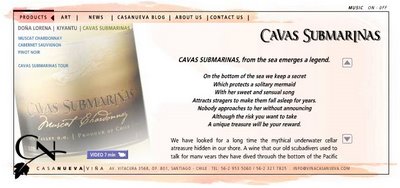
cava submarinas wine web site
I don't know quite what to think now.

When I heard about wine anarchists cellaring wine at the bottom of a frozen lake, I first imagined the move as state-of-the-art, then as a fanciful prank. In the end, I think it was a sincere gesture made by wine lovers who don't like being hemmed in by the often constrainingly conservative world of wine.

News out of Saint-Malo, France indicates that the ocean-cellaring of wine is branching out in new directions. This Agence France-Presse newspaper article published last month suggests the unusual deep-sea storage of wine is getting serious attention from the more traditional wine establishment.

And that means you know the marketers can't be far behind. Click on the image above for the seductive offerings of Vina Casanueva, whose Cava Submarinas line of international varietals is not packaged in cases of twelve but laid out willy-nilly in barnacle-encrusted treasure chests. It's in this way that Cava Submarinas better gives wine adventurers "a legend emerging from the bottom of the sea". For their latest campaign, the winery also is kind enough to suit you up with goggles and an oxygen tank: access to this submerged cellar suddenly becomes self-serve.

If you're a pirate, that's probably how you'd want it anyway. Blackbeard will really get off on the video shown on the Casanueva site. Check it out, matey.

TASTY MORSELS

July marks the end of the birthday season among my closest circle of friends and this year we were really treated to some of the finest food BYOW Montreal has to offer. Our last stop was Restaurant Christophe, perhaps the nicest place in the city to bring out your favourite bottles for uncorking. We drank Domaine du Silène des Peyrals, among others. The way the food, the service, and the dining room ambiance came together, it was a real transportive experience. Like stumbling upon the most perfect Paris bistro.

If we once again put off the deep-sea diving during our next round of birthdays, we would surely call Christophe. Or even sooner than the next round of fêtes. They re-open after the Construction Holidays end on Sunday.

20060124

Aussie rules: football and other wine competitions

This is the time of year when wine blogs go sporty. Why not? The Super Bowl is a chance for a big party and a great reason to uncork some easy-drinking, crowd-pleasing wine. But, since I'm Canadian, I had the Grey Cup -- the championship of the CFL (Canadian Football League) -- back in November. It was an amazing title match, decided in overtime. For me, all this Super Bowl hype gets redistributed to my focusing on the Australian Open. Hence my discovery yesterday that tennis star, Conchita Martinez, Open finalist in 1998, is a tremendous wine lover.

Wine and tennis have in fact been on my mind a lot lately, and not just in the context of January sports parties or Conchita Martinez. I saw a stunning movie called Match Point on the weekend. In it, Londoners work on their forehands but never miss a moment to enjoy a drink, courtside or off the grounds. Never having been to Wimbledon, I wished I could've been there with movie's characters, sharing their expensive tastes.

The movie was set among upper-crust Londoners, which probably isn't my kind (or my wallet's). Naturally, I turn to thoughts of the wine scene at the Australian Open, assuming that Down Under, wine would be much more affordable and approachable, if slightly more commercial. Turns out I am right. The tournament has a well-known wine company as one of its sponsors. So quiz time once again, is it that winemaker:


  1. Jacob's Creek

  2. Wolf Blass

  3. Rosemount Estates

  4. Lindemans


The answer is (b) Wolf Blass. Upon further investigation, I realized this should come to no surprise to anyone. Wine conglomerate Beringer Blass has been mixing sport with wine for a long time running, sponsoring Aussie Opens and Aussie Rugby Unions. After a little googling, it seems like Wolf Blass is the sporting wine of choice hands down Down Under. The company promises that this alignment is a winning combination, giving their product exposure to a key demographic, and one that for the tennis fortnight in Melbourne "tends to attract white collar viewers and are not necessarily male or female oriented". Or so says this article. Interesting marketing. And here's another way Wolf gets to the sheep.

In fact, Wolf Blass product placement goes beyond Australia, as it did just last week in Los Angeles for "GDay in LA" week, where "one of America's great ... sporting institutions, UCLA, [was] taken over by Australians on January 15 with the Wolf Blass Aussie Festival ... On one of UCLA's sporting fields, the Swans and Kangaroos [played] an AFL sanctioned exhibition game..."

Regardless of their winning approach, brands like Wolf Blass do not end up winning me over. I remain fixed on French wines, which for the most part supply me with plenty of value for my money. But if the money was on the line tonight, I would overlook my fondness for French and, like Wolf Blass's roots, look to a German. An East German man, not wine, to be specific. That's because Germany's Nicolas Kiefer will be playing France's Sebastien Grosjean in the quaterfinals at the Open. I do prefer the French for their wine but for tennis, I have to go 100% German.

20051208

"You're soaking in it," and other things best avoided

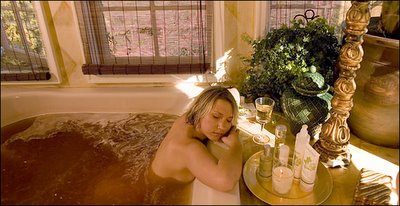
wine bath spa resort

Some blogs have a statement of purpose. I haven't written an entry like that yet. It's obvious that I only post about wine, but so do umpteen-hundred others. When I read the article published in the New York Times Travel Section this week, I felt more motivated than ever to say "this is the exact opposite of what I want to accomplish". This so-called free feature found in the Spa Guide reads like an ad dreamed up by someone who knows too much about marketing copy and much too little about the joys of wine. I cannot recall a flabbier, anemic story with an NYT byline. It's about the soft sell -- if you tart it up enough, you can sell anything to the most disinterested party. That fridge can be sold to this here Inuit family and these here readers who don't ever think to dine with wine might just be curious about a resort that oozes with so much wine you practically bathe in the stuff! Whoa cool!

It's reminiscent of a beef I had with the Beaujolais nouveau people. I can now say I prefer the stilted -- if somewhat informative -- blog and funky French acid jazz of their over-18 site to the pathetic Times advert for the Kenwood Inn. But I don't think Doktor Weingolb will see either one.

Snobby, aren't I? I'll admit there are audiences for dispassionate, commercial writing about wine. And there are audiences for November Beaujolais parties. (Here's hoping that they are one and the same and all the leftover vin nouveau can be put to use as bathwater.) The point is that there are plenty of people who couldn't care less about wine or what it really has to offer when it's not masquerading as shower gel. That's fine. I'm not going to win over many of those people in this space. Because that's just not the audience I want to cater to. And I am determined that that actually has nothing to do with snobism and everything to do with goal of achieving good writing. I'm not saying I'm a great writer (I can put up some really half-baked prose that visitors will turn up their nose at, and probably already have done). But to me, the best writing on the web is the stuff that targets its readers well. Then when you reach your audience, you've succeeded, no matter how much of a fool you feel like when describing a malbec as "robust, with hints of leather belts that are about ready to snap under the tangible weight and volume". Or however one's moved to express the gustatory experience...