Facebook!

Twitter

Tumblr


Showing posts with label SICILIA. Show all posts

20071227

Planeta makes my favourite wine of the year


La Segreta Rosso IGT Sicilia 2005 (about $16) & La Segreta Rosso IGT Sicilia 2006 (about $16)
It was late last year that I tasted this 2005 blend of Nero D'Avola, Syrah and Merlot from Sicily. It was bold and unusual, not what I typically expect from Italian wines in the price range, namely expressions of light to medium body with some tart damson plum or zingy black cherry.

There weren't much of those. Or at the very least, you could've said the Syrah packaging aligned the fruit flavours of the Nero D'Avola and the Merlot with newer world traditions: cedar, spice box, lovely roasted notes, substantial body. It was perhaps too young to drink in 2006.

Fast forward to the end of the 2007. It was November and great praise met the release of the 2006 Segreta reds. Swayed by the positive reviews, my friends and I went out to buy and taste it. Somehow we ended up with a bottle of the 2005 back in front of us. We didn't know it at the time we opened it up.

We didn't know it, except immediately I felt I couldn't be drinking wine that was less than a year old. Sure enough, this was the older vintage. Although bright and charming, there was a mellowness and fine integration to it. I wasn't taking notes at the time, but it didn't matter. It was one of those tasting moments where all the elements come rushing together perfectly -- jotting down individual components of the wine as they come to you doesn't apply when a wine is this whole, with this much integrity.

Many critics underline how tones of mocha and raspberries envelope one another within the beautifully tannic arc of the 2005. I'd go along with that. But it'd be a cop-out not to provide my own notes on a wine I'm proclaiming a wine of the year. Problem is that there is no more 2005 left where I am and all I can do is retell the story of not paying enough attention to wine labels and the happy mistake it created.

A TWO-IN-ONE ENTRY IN MY FAVE TOP FIVE

So this post for one of my five favourite wines of the year is actually for two different wines. The Planeta Segreta Rosso 2005 -- the wine that moved me -- and the the Segreta Rosso 2006 -- my great "red" hope for drinking in the new year. (Click on the first "drink now" bottle image above for 2005 availability in Ontario -- click on the second "lay down" bottle image for 2006, which is what the SAQ is currently stocking across Quebec.)

So meet the 2006 red Segreta... It's not the same wine as the 2005 by any means -- it adds Cabernet Franc into the mix -- but if anything, its critical acclaim has only grown from last year's reaction. For more technical details and press, see the Planeta website, which is making me want to visit all corners of Sicily with every mouse click. With any luck, in about ten months' time the 2006 will integrate as amazingly as the 2005 has done (isn't it interesting that the release date for the 2005 Segreta was only in August -- about a year later than its release in Quebec and perhaps much more timely). Without a doubt, I know I can look forward to 2007's edition to be bottled and shipped out soon from this island off the tip of the Italian boot.

(While I admitted to not having notes for the 2005 other than a fallible memory, my notes for the 2006 are very much hot off the press, and I might add, rather hastily arranged from a BYOW dinner at a small, noisy, and dimly-lit resto, just moments ago.)

Eyes: Brickish red, but with intense hues and quite opaque.

Nose: Earth, thyme, hints of cooked fruit? Developing...

Mouth: Savoury attack, with stewed vegetables and ripe tomato, grippy but with a silky texture and somewhat woody.

Stomach: Garden fare done Italian-style, hearty pasta with sausages, bold herbs, anything oven-roasted.

20070129

Spadadora's DiVino at 25% off: On sale and still racy

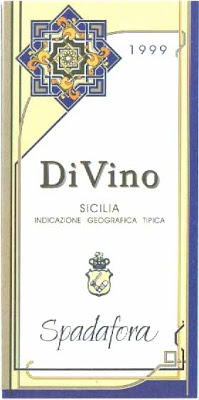
spadafora divino sicilia 2003 i.g.t white wine chardonnay grillo inzolia blendIffy storage conditions and a wine's eventual oxidation often come to mind at any liquidation sale. The SAQ may be liquidating many bottles, but of all the ones they are discounting and of all the wines I created a handy cheat-sheet for, the most suspect bottle, a Sicilian white blend released a few years ago, ends up as my surest bet.

I say that because I've just checked on it and the Spadafora DiVino 2003 (image at left shows an earlier vintage) is doing fine. And not just fine as in passable, but fine as in status quo. Over the last 12 months or so I tasted it many times and each prior tasting seems to have nothing on the one that follows. I actually had one of these bottles tucked away in my fridge from the last time the SAQ discounted this wine (it was 20% off then but now it's even more steeply reduced). Opening it last Saturday night, I was worried it would be past it but it surprised me. Not bad at all for a style of wine that is without any promise to age and proudly considers itself drink now.

Or at least that's what the experts have said. It is however a blend made up of some seriously consistent Chardonnay grapes, which when handled right can develop nicely with time. But perhaps the consistency comes from another component of the blend. The Chard is added to the regional grape Inzolia (which along with compatriot Sicilian varieties Cataratto and Nero d'Avola are a lot of fun to say). Inzolia typically makes a viscous wine and its flavour profile of nuts and citrus are... yes, in fact they are similar to Chardonnay's as well. The rest of the blend is composed of Grillo, which mostly considered a Marsala grape.

In any case, the wine was perfect. I forgot how good this $20 bottle was. Priced now at only $14, it's showing off its golden-green hue. It's still got the exotic aromatics on the palate. They act as a buffer to its lovely structure and great richness. Don't serve it too cold. There's an edge of raciness too, for it still possesses a crispness -- fresh and dazzling.

Do buy now and do drink now. But clearly, if you do have to hesitate somewhere along the line, you're better off hesitating in opening it, after you've picked it from the SAQ. For though it's clear that there's life yet in this wine, its other shelf life -- its time remaining on SAQ's discount displays -- is clearly limited. This morning there were four bottles remaining in the downtown Montreal area but now as I write this there are none (luckily I got two of them).

So don't wait in buying it. Once store locations lose their stock, the price will eventually go back up. Back up to $19, that is, if the stock ever returns. The winemaker's site makes no hint of continuing to produce it.

Perhaps that's the real reason for the markdown: neither problem storage nor wine in decline, but simply catalog deletion, which is my favourite type. It's not a bittersweet goodbye, I tell myself, it's just "going out in style".

Dei Principi di Spadafora, Palermo, Italia. 13.5%.

20061107

Making do with mini reviews: Corvo Duca di Salaparuta 2005 (bianco)

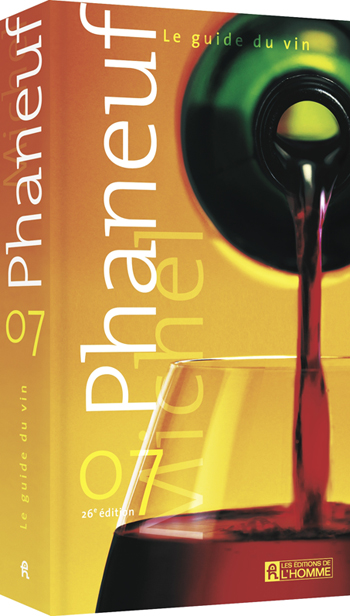
le guide du vin 2007 michel phaneufNote: Yesterday I trumpeted the upcoming release of Michel Phaneuf's Le Guide du Vin 2007 hoping that today would be the day that wine lovers would find it on sale in bookstores. Not so. Librarie Renaud Bray, which probably has more copies on order than anyone, is still awaiting shipment and none of its stores have it. Since Tuesday is usually the day of book releases, the guide likely will be delayed for at least a week (online catalogs seem to have replaced a date of October 24 with November 14). I've also now heard that Phaneuf's publishers will savour the timing offered by the Salon des Livres happening November 16 to 20 in Montreal.

Weingolb will now present some tiny reviews I've done in the Phaneuf style. Over the next week -- except for tomorrow which is Wine Blogging Wednesday -- I will use star ratings and cellaring rankings to evaluate wines, and the wines will be ones that Phaneuf has assessed but in previous years. No, it won't replace the need for a new Guide du Vin but it may satisfy the intense desire for a wine buying guide that always hits around this time of year.

Corvo Duca di Salaparuta (bianco) Sicilia 2005 $13.55

The regional grape varieties in this intriguing blend are Inzolia (sometimes written Insolia) and Grecanico. The resulting wine is appley, but very nicely structured. This is a bargain. Inzolia typically makes quite a meaty wine for a white, offering body and richness. With some spritz provided by the Grecanico grape, Corvo supplies superior refreshment value with some dimension to it.

Drink young for its full flavour profile: 1

***½ (Three and a half stars, or three stars plus extra mark for being a bargain)

20060928

And then Nero d'Avola gets into the mix: Tenuta Rapitalà Nuhar 2003

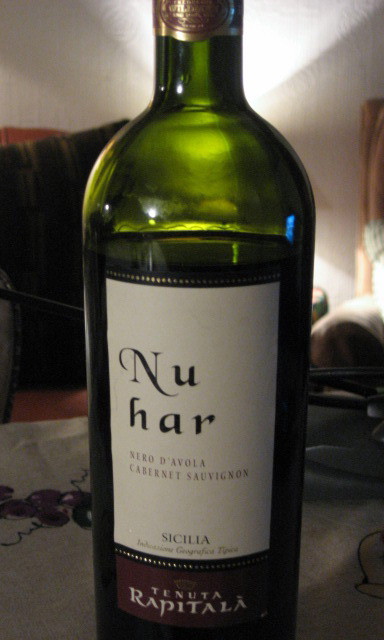
Tenuta Rapitalà Nuhar Nero d'Avola Cabernet Sauvignon 2003 nu har
I've had tasting notes for a Silician red blend that I've been meaning to put up for some time (and I've alluded to this fact in my last fan mail entry). Just as I was uploading said notes this morning, the annual Tre Bicchiere Italian wine awards began making news. The announcement is important for several reasons, but since we're on the topic of Sicilian wine, I will highlight one significant point that on this day Jancis Robinson reacted to in particular: Sicily is getting more recognition than ever.

While Tenuta Rapitala -- producer of the wine that I'm reviewing today -- does not get recognition this time around, Corvo (Duca di Salaparuta), Planeta, Tasca d'Almerita and Donnafugata all do. These four producers make cuvées that round out a list of 15 honoured Sicilian wines, a number that is up three from last year's list. All four that I've mentioned, as well as Tenuta Rapitala, are available in Quebec.

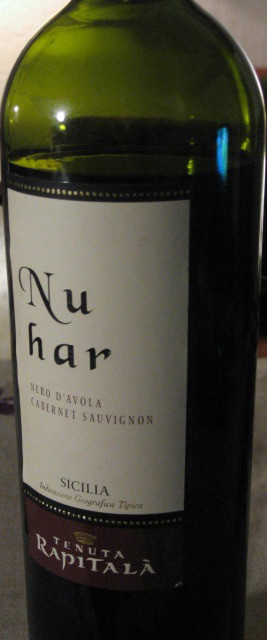
Tenuta Rapitalà Nuhar Nero d'Avola Cabernet Sauvignon 2003 nu harThe bottle that I'm writing about and that you see pictured here, was a prezzie I picked up in New York this summer. Tenuta Rapitalà Nuhar Nero d'Avola Cabernet Sauvignon 2003 is the bottle. (Nuhar appears as two words "Nu har" but apparently nuhar is the arabic for flower.) It's an affordable quaffer, but the nearly as much as its little brother is. That one is strictly a Nero d'Avola varietal and it is both less expensive and more expressive (a swell combo) and on sale locally (follow the link). The Nero d'Avola varietal from Rapitalà makes for a very enjoyable, distinctive wine, but I think I gravitate more to Rapitalà's Nero d'Avola blend. I love Nero d'Avola to be sure, but it can hit rough patches and end up lacking some smoothness.

Corvo seems to approach this by blending the variety with regional grapes Perricone and Nerello Mascalese. The resulting wine is supple and ripened and retails for a similarly inexpensive price.

But back to big brother Rapitalà I got in New York. It takes takes on Cabernet Sauvignon to add great suppleness and deep structure to the Nero d'Avola. This really makes it sing, and I would be so bold to suggest that it's this kind of fine work that is getting Sicilian winemakers noticed so nicely at this point in time.

NOTES FROM MY TASTING

Rich magenta tinge with a sweet and supple aroma. On the palate, there is a brightness to it and definite lift. Buzzy mouthfeel. Loads of gorgeous fruit though not jammy; smoky notes, though not too woody. Grenadine up front and blacker fruit on the finish. Full and luscious with nice balance and some smoothness, if a bit rustic overall. Good with a hearty lasagne.

NOTES ON THE LABEL

Two wine varieties: the Nero d'Avola rich in tannin and body and the Cabernet Sauvignon which responds to the heat of Sicily with colour, softness and depth unlike elsewhere. A wine with strong notes of fruit, warm, full, balanced and mellow tannins achieved from barrel ageing.

Camporeale, Sicilia, Italia. 13.5%

20060413

A splurge for Easter: Ceuso Custera 1998

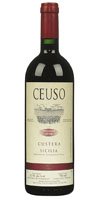
Ceuso Custera 1998 expensive sicilian wines
Exactly one year ago, I changed a fundamental wine-purchasing behaviour in me. It could've had something to do with Lent ending and the Easter holidays arriving. Or it could've had to do with lent money and Easter wine sales arriving: I decided that I could (and should) start appreciating wines in the $30 to $40 range.

WITH MY SAY-SO

I happened upon a 25% off sticker on a bottle of Sicilian wine: Ceuso Custera 1998 (which I like to think is pronounced "Say-so!"). I figured that I enjoy everyday Sicilian wines -- wouldn't forking out an additional $20 make the experience with these southern Italian reds THAT much better? Besides, I was getting a deal: Spending less than $30 on a $40 bottle of wine. Surely this would be three times as good as Corvo, that lovely $13 standby from Duca di Salaparuta.

Mistake? The math might be right, but is the theory sound? These days, I have the wisdom to realize that wine prices are not set to scale with level of pleasure. In my experience, any semblance of a reliable scale will evitably crap out, usually somewhere around $21.85. After that you never know if you are paying for a name, prestige or a piece of history, all things that tend not to fare very well in a blind tasting.

THAT MAGIC MOMENT

But there I was at the cash, ready to take advantage of this sale. On the store's bookshelf, I had found a fairly positive sentence or two by way of review, and that was enough to guide me to my purchase. I expected anything else that was to follow to be measured by intangibles. After all, this was a wine worth more than any other I had ever bought home.

Actually, I had paid $40 for a single bottle in the past. But that was Champagne. $40 is strictly entry-level when it comes to a Black Label Lanson. A $40 Sicilian, on the other hand, is the total opposite -- it's pretty much through the stratosphere when it comes to this relatively rustic wine-producing region. There was going to be a genie jumping out of this bottle. I just knew there would be.

But later on with in-depth research on the Internet I heard the voices of many wine critics and industry authorities. While lauding the efforts of the winemakers that tended Ceuso's exclusive Custera vineyard, they cried out their alarm at such immodesty form this producer: a big and showy Bordeaux-like label, the brash trumpeting of stylish international grapes, and an indulgently-set price tag. This wine was good, they said, but with an elevated price. Never mind my Visa balance, would my modest discernment and young palate really be able to get around this Sicilian avant-garde?

What had I gotten myself into?

Another person might've holed away the bottle in guilt and then try to forget the extravagance. Me, I pretty much opened it on the spot, all by myself, for a look-see. There was still a few other bottles of the stuff remaining and I wanted to find out if I should scoop up more of this mark-down.

Well, short answer is yes, and I did buy another bottle which I kept until now. Regardless of pricing and all the reviews, this wine is for me. It's my style, and at one bottle per year, it's also a squeaker for my budget. As I await the 1999 vintage for my third purchase, here are the ravishing tasting notes from my second Ceuso.

WHAT I PAID FOR

The majority of the Ceuso Custera is made up of Nero d'Avola grapes, but Cabernet Sauvignon and Merlot are blended in to make this bottle part international, part regional. To the eye, this wine is muted garnet with brick edges. Clearly it is showing some of its age.

Ceuso is redolent with intriguing cedar flavours, an attribute that I often sense verging toward corkiness but not in this case. It's a warm and welcoming embrace. The aroma features blackberries and candied cherries with dusty tobacco on the palate.

On the second night, I was quite amazed at its evolution, so you may want to donate to this wine a portion of time in a decanter, despite its eight years. Drinkers may miss how, given time, Ceuso's gripping dryness melds with lingering fruit and vanilla notes for a fantastic finish. Now I know why I bought more of this wine: it was after I tasted it on the second night that the decision was made.

Alcamo, Sicilia, Italia. 13.5%.