Facebook!

Twitter

Tumblr


Showing posts with label VISUAL BLOGGING. Show all posts

20071127

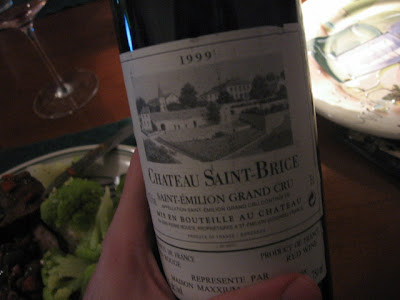
Château Saint-Brice Saint-Émilion Grand Cru 1999


Does this look good enough?


Good enough for this?


I could hardly be sure: This is my first grand cru. A fairly well-reviewed wine described as an expensive but not overpriced product from one of the celebrated châteaux operated by the Moueix family. I found this bottle -- the "second wine" of Château Magdelaine -- at a steep discount of 25% off after it had done some cellaring but was still very much before it's best-before date. Click on the image above for the SAQ's descriptive file on the current vintage.


Eyes:

Nose:

Mouth:

Stomach:

Sorry, no notes on this one. I really wanted to enjoy it, let it wash over me without an expressly critical approach, and see how it would change me.

What has changed? I have to say, not much, so perhaps that says it all. But if anyone wants more details or has a specific question you can email me.

20070926

How to interpret a wine labeler

The last entry in Wine Label Week was entitled "How to interpret a wine label" and featured good tips and valuable lessons on getting important facts from a wine label. It just might make dinner go a little more smoothly if you carefully examine that label on the bottle. The label is going to give you some good clues on what the wine will taste like without uncorking the bottle.

Here's another label that's worth a gander.

jay moore o and sons pinot noir burgundy red wine
... But not so much for what it tells you about the wine contained inside. More than anything else, this is a good example of how, based solely on a wine label, you can tell a lot about the wine labeler:

upside down label on wine bottle

Drunk!

Stay tuned tomorrow as Wine Label Week continues because I will post what I'd say was the most unanimously reviewed best-value wine of the summer. Hint: It's definitely got a label.

20070924

Labels... Who needs them?

spanish red wine label guide how to interpret what that wine label meansWe all need them. I'd go freaking nuts if there were no labels around when it comes around to wine time.

The wine label on your bottle indicates so many different things that shape a wine on many different levels. We're talking appellation, place of origin, type or style, vintage, alcohol level, producer, vineyard, bottler, or importer... the list goes on and on and each of these things greatly affects whether you're going to best appreciate the bottle.

WHAT TO LOOK FOR ON A LABEL WHEN SURVEYING A WINE BOTTLE

The following are the main categories suggested by Jancis Robinson as the typically mandatory bits of information on a given wine label, although national or international minimum criteria may be stricter on a local or regional basis.

For each of the following label information categories, I've included a real-life example. The example is based upon the Prado Rey bottle of wine you see pictured at left. Click on it to enlarge it if you wish to follow along with what's what on a typical label.

- Wine designation: Denominación de Origen (or D.O. -- an official Spanish appellation desginating quality)
- Geographical reference: Ribera del Duero
- Volume: 750 millilitres (standard wine bottle size)
- Alcoholic strength: 13%
- Vintage year: 2001
- Name and address of producer: Real Sitio Ventosilla (S.A.) Gumiel de Marcado, España, EU (it's Spanish wine!)
- Bottling information: Estate bottled (written in red across the image and since I bought this in Quebec, it's also in French print mis en bouteilles à la propriété -- is that missing "r" a typo?)
- Varietal information: none specified (this is likely a blend of grape varieties)
- Gratuitous government interference: something on the back about containing sulphites
- Sweetness: none specified (most wines, especially dry wine which are in the vast majority)
- Fizziness: none specified (this does not apply since it is not a fizzy wine)

I would also add these other types of information to look for on your wine bottle.
- Product Origin: Spain
- Type of Wine: Red
- Style of Wine: Crianza (separate top label, cut off from photo)
- Importer: Bergeron-Les-Vins
- Product Number: +929034 (useful when shopping for a specific bottle)
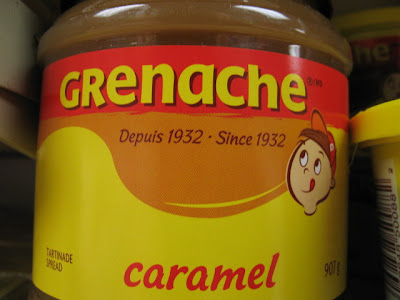
grenache tartinade spread when is grenache not a grapeBased on this, you glean a few things from the wine you are about to uncork.

WHAT NOT TO LOOK FOR IN A LABEL

One major way the label helps is it signals low quality as in serious plonk or if you're in for an unpleasant surprise. I'd say be careful if your label doesn't sport at least five of the label items listed on this page. Otherwise you might be in unchartered territory.

For example, take the contents held in the glass container at right. Sure, you've got grape varietal information (Grenache), volume -- oh wait that's weight (907 grams), and something vague about the producer being in the business for a long time (Since 1932 -- glad that's not the vintage year!) ... ah, how old-fashioned and quaint. But don't be fooled! That "caramel" claim is not exactly a suggestive wine tasting note.

As a wino, I'd definitely avoid cracking open this one.

Never trust a wine that you can spread with a knife! (Or, for that matter, a wine label that depicts children licking their lips...)

20060801

Introducing Snakshots by Doktor Weingolb, chowtime operative

snackshot pictures of snacks food photographyEver since I got my spiffy new digital camera one month ago I have been unable to arrange enough online space for my food and wine photographs. Doktor Weingolb Snakshot changes all of that right now.

VISUAL FOOD DIARY LAID OUT LIKE AN ALL-YOU-CAN-EAT BUFFET

Snakshot is a simple but accommodating home to all the images of snacking that don't get a proper write-up or index entry on Weingolb. At heart, Snakshot is a visual food diary. Yet it possesses the strong spirit of an all-you-can-eat buffet. And yes, I personally have eaten what's being depicted, which means that this makes for some nice voyeurism. So live vicariously and check it out. It's a feast for the eyes and it's constantly piling up.

Backwash

Starting today, other enhancements are materializing on Weingolb, which is good because I've been getting more visitors than ever. A little housekeeping goes a long way in making folks feel at home, or at least that is my hope.

In addition to the prominent link for Snakshot in the sidebar, index entries have been rearranged. The goal here is greater usability. I've had comments that finding entries on specific wines are hard to track down so now posts that feature specific wine reviews are separated from posts on food or other dining topics. This should make scrolling down the alphabetized listings a bit easier, though knowing the appellation or grape variety of the wine you are looking for is still key to finding what you want. As always, the Search This Blog tool at the top of every page is time-and-again the smartest way to navigate to your desired information.

Secondly, I wanted to make the Weingolb archive display in chronological order. That way, things flow in a natural order when you scan through one of the previous months bulleted at the bottom of every page. You can read in the same direction that entries were posted and adhere to the chronology of the blog. A minor issue really, but in the end I found a fantastic JavaScript patch from Casa Patologico, a Spanish/ English-language blog. It always presents to you a choice on how posts are displayed, on both headline pages and archive pages.

20060426

Today's post: "Sauvignon Blank"

This space is devoted to reaction to the recent claims of Mike Steinberger, who wrote that the Sauvignon Blanc "grape is a dud, producing chirpy little wines wholly devoid of complexity and depth ... limp, lemony liquid that grows progressively more boring with each sip."
drawing a sauvignon blank