Facebook!

Twitter

Tumblr


Showing posts with label DÃO. Show all posts

20071012

SNAKSHOT: Filet of fish and Quinta de Cabriz Reserva 2003 meet for dinner


This was a fantastic meal prepared by my sister and her boyfriend on April 2, 2007, already a half-year ago but still strongly etched in my mind.

It wasn't Easter dinner but it was a very sophisticated dinner, yet stunningly simple in execution. Lucky me -- I got to watch, and point my camera.

When I arrived for dinner, the strong smell of soy sauce met my nose. In the kitchen, fish fillets were marinating in a baking dish. The aroma was pungent and I got the idea of offering a pairing by way of one the Portuguese wines I brought with me.

The final dinner preparations were made as I nibbled and shared a Cheverny aperatif that I knew would be just my sister's style of wine and it was. I was more apprehensive when it came to selling a sturdy Portuguese Reserva with such a very white fish. But in the end, my Quinta de Cabriz Reserva Dão 2003 made perfect sense since the Portuguese diet is replete with heavily flavoured fish dishes, be they charred, smoked, grilled or broiled.

Our fish went into the salamander under the oven and was cooked to perfection. You can see this in the photo above, and how the tasty marinade worked its way into the fish flesh, generating a big flavour punch to the palate. A punch that my wine could stand up to and flatter as an accompaniment. And yes, even a blood orange garnish wasn't enough to throw off this wine, though you wouldn't except much from pairing a red with some citrus. Yet the signature profile of spice and orange confit in many good Portuguese wines permits this match too.

There was a gasoline-y note in this wine that some might call tarry or mineral. It coats the tongue in a certain way. You know it was you taste it. The assertive treatment for the fish penetrated this effect of the wine and then proceeded to dazzle the tongue with its own "umami" seasoning -- something I don't think my more restrained and elegant wine from WBW 38 would have allowed the food do as well because it is so much softer.

The Cabriz Reserva, which is composed of Alfrocheiro, Touriga Nacional and Tinta Roriz indigenous grape varieties also offered strong berry fruit with palpable acidity to cozy up to the creamy pasta side and make some nice contrasts. But all I can really say is that we lucked out, because this was not only the first time I uncorked this bottle, but the first time I had ever seen it. I bought it at the LCBO moments before I walked through their door.

I love Portuguese wine.

Thanks to those who inspired this post: Ryan and Gabrielle of Catavino who hosted WBW 38 on such a great and ripe topic; Sonadora whose compliments on my dinner photos got me to go over a long-neglected food photo album; BrooklynGuy whose interest in deciphering these red blends put me into a pairing-analysis mood; and finally to Kristen and to John for their totally memorable dinner. It was a treat! Cheers.

20071010

WBW #38 Portuguese table wines: Quinta dos Roques Reserva 2003


Note on the terminology of WBW 38. "Table wine," in its broadest and most international sense, is wine of average alcoholic strength rather than those strengthened by the addition of alcohol, like fortified wines. But throughout most of the EU, "table wine" is a category of wine that has no official classification. For these wines, a vintage and a designation (like the Dão D.O.C. designation from Portugal that we see below) are not included in the labeling information. Furthermore, in Portugal, "table wine" might be construed as an "IPR" or Indicação de Proveniencia Regulamentada, which is a designation secondary to the top-tier D.O.C. system. WBW 38 is clearly focused on Portuguese wine other than Port wine or, in other words, those specified by the international definition of table wines -- simply the wines you'd find at the dinner table, and in that sense it is "table wine." Nevertheless, on these web pages, table wine is regularly used to indicate the EU/French definition. On these pages, WBW 38 wines would not be referred to instead as "table wine," and SAQ.com suggests that they be called "meal wine" which is a suitable name because Portuguese wines are fantastic for pairing with food.


Big ups to Ryan and Gabriella at Catavino for organizing a Portuguese WBW. It definitely seems about time. These two bloggers are doing some serious justice to these wine regions by hosting a ton of great resources on their site and by inspiring winos everywhere to get out and taste the indigenous grapes of Portugal. Their web pages are very much worth checking out. They allowed me to get my hands on a definitive list of Denominations of Origin or Denominações de Origem -- the 25 wine designations that Portuguese wine carry as a seal of quality.

I didn't realize that there were that many D.O.C. designations in Portugal. While I am no stranger to wines that reach beyond the Douro -- the Ribatejo, the Alentejo, the Estremadura, Vinho Verde, Palmela and Dão -- it now appears obvious to me that the first country I would visit for its wine regions would be Portugal, hands down. I look forward to reading more WBW 38 entries on these wines of Portugal, that at their best are both tenacious and lovely.

My entry to this month's theme is a bottle I've been meaning to try for a long time. I wrote a bit about why I've been wanting to taste it here. See the notes below for what it actually tasted like. Overall I was surprised, no doubt because I don't recall ever opening a Portuguese wine at this pricepoint. ($30 is definitely what I would call the upper register of the range of my value wines, though a wine bargain can surely come with any price tag attached to it -- it just depends on what's inside.)

Quinta do Roques Reserva Dão 2003

Eyes: This looks like one of those unwieldy and heavy glass bottles -- yup, it is. I keep staring the bottle down but still note that the wine is not as darkly pigmented as I would expect. Somewhat mellowed red hues and no bright purplish tinge I was expecting. A silky smooth consistency.

Nose: Yum... This is typical. A spice box with notes of cooked bell pepper. When Portuguese wines carry Loire Cab Franc aromas, I know I'm in for something good. Some diesel comes through too. Over time, the nose on this wine gets warmer, more embracing yet complex. Subtle and not at all intense. This is some absolutely elegant nose perfume.

Mouth: Zesty orange rind and fruit compote flavours up front. Some characteristic attributes are present -- chocolate, cinnamon and gasoline -- and arranged in elegant proportions. Animal too? This is Portuguese elegance. Softly moves through to a nice middle and a lovely finish. Luscious medium body is unique and interesting, but somehow makes the length seem shorter. Acidity is a little less than lively, but present, which offers this wine a tremendous arc built around a reliable (but thoroughly integrated) tannic grip.

Stomach: Don't deny the stomach -- this is table wine or meal wine or whatever you want to call it, so bring on the bouffe. All of my tasting notes came alongside a simple dinner, pictured in this post. Without food, this wine was coming off unnecessarily vegetal and cold, strangely lacking intensity. Food makes it less austere and adds an attractive element of synergy.

With food of all types -- salty, savoury, bitter and sweet -- Quinta do Roques Reserva Dão 2003 makes your dining experience so much more than the sum of its parts. Try it with the sweetness of Grelot potatoes sliced and then boiled in chicken stock, served with a sprinkling of pickled olives and the saltiness they provide. Or have it with the mild flavours of pork cutlets broiled with thyme and lavender served on a savoury bed of caramelized onion with rosemary. Even the pungent and slightly bitter arugula salad tossed with dry-cooked mushrooms for added richness is heightened by a red wine like this.

Mangualde, Portugal. 13.5%.

20070823

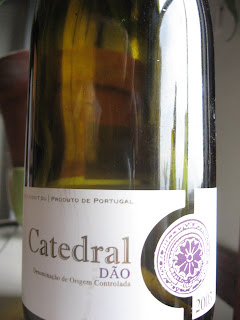
DO NOT CONSUME WITHIN 24 HOURS OF OPENING: Catedral 2003

dao red wine portugal
It was getting to the point that I thought I would never meet a 2003 Dão that I didn't like.

First, I fell in love with Casa de Santar. At under $15, I ended up buying out all LCBO stock.

Then, once those bottles were emptied, I turned to the Quinta de Cabriz in the adjoining Vintages carrel and it was just as good, if several dollars more.

I thought it was a hasty decision to venture over to Sogrape's cheapest of cheap, the 2003 Grão Vasco. For the $8 I paid, it was a-okay -- perfectly functional at a price few wines are.

I was on a roll and wasn't ready to stop. The 2003 Quinta dos Roques was next in my sights but before I located it in the racks, I came across a nouveauté in the Portuguese section, which is pictured at top (click on the image for product details).

It was the Catedral Dão 2003 and snapped it up without giving it a second thought, saving the more expensive Dão product for a special occasion. Quinta dos Roques would have to wait.

cathedral capivor 2003Funny though, there's no quinta mentioned on this Dão. Capivor is the bottler. Who knows what vineyards this stuff came from.

And those were the last thoughts that resounded in my head as of the sudden I realized that my luck had finally run out.

A caramel nose with roasted fruit is rather muted.

On the palate, there's cinnamon, tangy bramble berry and something else but it all quickly falls away into pithy, inelegant tannins in a long bitter fade.

A totally flat finish too. Maybe when the tannic punch is that green, harsh and astringent, it's considered as a blessing.

This is really unforgiving wine as there's not a single thing it seems to do well. There's about as much structure as a pile of logs in a do-it-yourself cabin builder kit. There's not many foods that will help it along either. Lighter food items only succeed in bringing out a strong burnt rubber aroma and mostly sourness. After I ruled out everything I had in my kitchen that contained salt, I decided mustardy salads managed the best.

I have to admit that on the next day this wine was much more integrated with forgiving tannins and, though overall it still is short of having any kind of an arc, it does helpfully illustrate the need to aerate harsh wines. That's the bright side.

This is one 2003 Dão I'm happy to see the back of.

Penafiel, Portugal. 12.5%.

20060911

Anything But Sangiovese: Tomato sauce + a couple of savoury (and non-Italian) reds

Nothing against Chianti. I love those lusty Sangiovese-based wines, especially when it complements rich Italian sauces or other wonderful regional dishes that are centred around the tomato. It's just that no one ever seems to think it's desirable to serve other wines with tomato sauces. I'm here to say you can. In fact, sometimes you should.

Especially when you've got local superfresh tomatoes to work with -- like now, in September. Then you get the urge to make a cruda-inspired tomato sauce. Cruda style means minimal oil gets integrated into your farm-fresh vegetables. The veg cooks in its own natural juices and intensifies itself while it cooks (see my recipe at bottom). Naturally, cruda makes me think of a lighter-bodied, less opulent wine than the Sangiovese that a fine Chianti often features. Also, I think cruda sauces are less acidic than others. To be enjoyable, wine always has to have at least as much acid as your food. Since the acid in the sauce is going down, you can also scale down the acid content and choose a less acidic wine. Being low in acid is not something Chiantis are known for.

casa de santar dao portuguese red blend domaine ruault saumur champigny cabernet franc 2003So I dropped the Chianti Classico and instead served my fresh tomato sauce with a Cabernet Franc varietal from Saumur-Champigny and the regional Dão grapes of Portugal's Casa de Santar, which in 2003 produced a surprisingly sauve and smooth cuvée, made to order for a tomato sauce topped on a fresh white fish like tilapia. In the end, that's exactly how I decided to serve my sauce.

THAT'S ITALIAN?

Here's how my homemade tomato sauce paired up with these two decidedly un-Italian wines. The 2003 Domaine du Ruault from the Loire was light but it still had very full flavour profile. I opened it first, so we drank it next to the appetizer course: homegrown orange cherry tomatoes (yes, more tomatoes!) on a garden salad. The Cabernet Franc lended the starter notes of licorice with vegetal and herbal underpinnings. It had some sharp edges, which made this wine coarser than the Chiantis I often drink. Nevertheless, with its tannic punch, it went on to measure up against the tomato sauce.

It was not long at that point until we opened the Dão. Casa de Santar Tinto 2003 had more body and was welcome as we continued on our main course. This Portuguese wine harmonized with the sauce well, supplying rounder fruit than the first and a lot more spice too. To me, this wine approximated a Chianti in an interesting way. Nice acidity. Definitely showing the rustic charm of Portugal yet conveying an Italian savouriness and an earthiness. Stewed prune notes harmonized with the tomato-bathed fish, which I served with a side of leeks and long-grain rice medley.

These two wines were prezzies from Ontario. The LCBO stocks them both and you cannot get either one in Quebec. Neither is in the general repertory section of the LCBO so you may need to research their availability a bit before you come across one. Locate Casa de Santar Tinto 2003 or Domaine du Ruault Saumur-Champigny 2003 before they sell out.

If you are successful, why not try them, especially the Dão, with my sauce. Here's the recipe, as promised.

Fresh tomato sauce


a half dozen large locally-grown tomatoes, the more bumps and surface blemishes the better
several sprigs of fresh garden basil, roughly chopped
an onion, in fine dice
three bay leaves
one tablespoon olive oil
sea salt and fresh pepper to taste
capers (optional)
chopped kalamata olives (optional)

Fill a very large sauce pan, deep pot or dutch oven two-thirds full with salted water and bring it to a boil. Reduce heat to medium-low and immediately blanch the tomatoes: Over a period of no longer than thirty seconds, submerge the tomatoes one-by-one and then fish each back out again.

Set aside the tomatoes, green stem side down while you discard the water from your pot and return it to the stove. Add the tablespoon of olive oil to the pot and then begin to soften the diced onion. Sprinkle with some salt and pepper. Reduce temperature further and stir if onions start to brown.

Using a sharp blade, score a small cross at the blossom dimple. Peel back the skin at each of the four corners you've created (While your tomatoes will already be in position to do this easily, you will find they are not too hot when handled carefully -- many cookbooks instruct that a bowl of ice cubes and water are necessary but I do not do this. As a result, you may get a bit more of the tomatoes on your fingers in peeling off the skins. This is because the internal cooking of the tomato was not halted by dunking it in cold water; however maintaining internal tomato structure is not important since we're making a sauce. And you'll love licking the delicious -- magenta, you'll notice -- and suddenly heightened-in-colour tomato goo off your fingers once you're done peeling anyway.)

Over a bowl or the pot, halve or quarter your peeled tomatoes so that they are easier to hold. Then pick up and thinly slice each tomato directly into the pot. Add any juices you've accumulated in your bowl to the pot. Bring it to a low boil and simmer for about 30 minutes.

After simmering the sauce, taste it to see how naturally sweet it is. Add the chopped basil, along with salt and pepper to taste. Optionally, add capers or kalamata olives to inject some savour and enhance the complexity of your sauce. Stir. (At this point, many cooks taste the sauce and then add more oil or red wine vinegar to give greater balance to a sweet sauce. Since fresh tomatoes we used give out more liquid -- and since we have plainly refused to waste the jelly, seeds and ribs that are often scooped out from the tomato and discarded...why? -- adding more liquid ingredients at this stage will create the need for further reduction and dull the fresh basil flavour. As a result, I opt here for olives, instead of olive oil and capers instead of wine vinegar.)

Pour the sauce atop pasta, fish filets (tilapia, halibut, cod, wall-eye, etc), or grilled eggplant slices and serve.

QUICK FIX: If ever the sauce is still too liquid.
Sometimes presentation is important to the dish you are serving your tomato sauce with. Sometimes you just can't wait for thickened sauce. Don't use a slotted spoon to let the runny juices behind. Strain the entire pot through a fine mesh. Then use the remaining bright rust-coloured juice instead of a water bath to cook your fish filets. Or reserve it for boiling pasta on another night when don't feel like making a sauce but still would like a treat.