

WBW #27 Icewine: Graf Hardegg Steinbugel Seefeld Weinviertel 2002
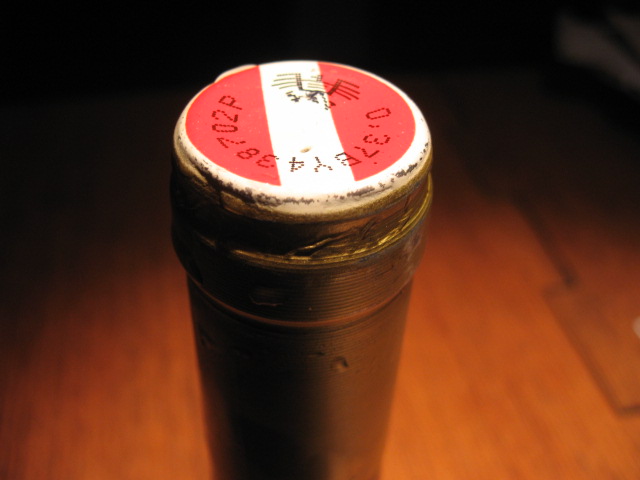
It was a pleasure to be able to have my first encounter with an Austrian wine for WBW #27 Icewine, hosted by the The Kitchen Chick. And, being the Niagara boy that I am, I've had plenty of icewines, but never an eiswein. (Rarely does the New World obscure the Old World in my wine repertoire -- I think this must've been the only exception to that.) It's great to have finally tasted the European stuff with this bottle of Graf Hardegg Riesling Eiswein Steinbugel Seefeld Weinviertel 2002, which is quite a mouthful -- both saying it and drinking it. But before I get to the tasting notes...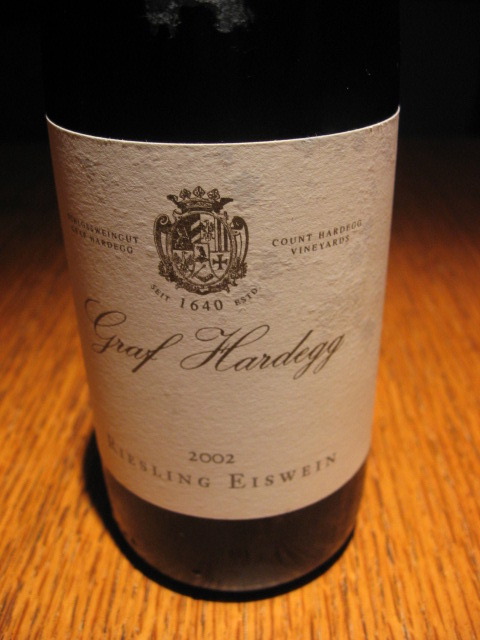 Ahead of uncorking this eiswein, I found myself taken in by some interesting cultural-political markings on the bottle label. The crest was beautiful and the label it was on was even more striking. A minimal design on lovely parchment. To top it all off, the capsule was one of the most miraculous I've seen. It was copper-swathed along the shaft and at the cap a round version of the Austrian red-white-red triband proudly displayed a clever dot-matrix black eagle surrounded by more dot matrix printing, somehow done in a circle. A little background on Austrian symbology and legend is here, if you're interested. Personally I just liked admiring these decorations, making sure I got my money's worth.
Yes, all icewine is expensive, and this eiswein is no different, though I did get a good deal on Graf Hardegg Riesling Eiswein. So finally I went in to taste it.
A golden hue and an immediate aroma of petrol poured out, reminding me of the best Rieslings I have tried. This was a good sign. On the palate, the first sensation was of buttery viscosity. There was honey, agrume flavours, great depth. A nice prickly feeling around the edges of my tongue confirmed that this Riesling expressed its acidity and forged great structure and length. I found this assessment of the wine online:
Schlossweingut Graf Hardegg, in the Weinviertel, "produces brilliant eisweins from riesling with a very fresh, clean bouquet that brings to mind extremely cold but clear winter days in northern Austria." These eisweins, he believes, "are not sticky but quite lean, elegantly structured and very, very impressive.I would agree. (Jamie Goode has a page on the wines of Graf Hardegg.)
As this was an occasion to taste such luxurious stuff, I had planned ahead for a suitable dessert pairing. A tart of apricots and pistachios echoed the sharpened and sweet fruit flavours. And it was while having dessert that my fellow diner Eric pondered over the Graf Hardegg back label, written in German -- a language he knows well. We could tell that the information was describing the harvest of the frozen grapes, supplying the exact location, date, and time of day, but most was not a term he made sense of, as in Most 31° KMW. I blurted out something about wind direction and then we proceeded to go through about four translation dictionaries before we finally figured it out by simply pulling out the Oxford Companion I bought last month. It ain't wind.
THE DEVIL IN THE DETAILS
The entry for the initialism KMW was the easiest to locate immediately. I found that it stands for Klosterneuburger Mostwage, which is Austria's standard measure for grape ripeness or "must" weight. And must weight is important because it indicates the concentration of dissolved compounds -- about 90% of which are sugars. This of course determines fermentation and what the final alcohol content of the wine will be.
In this case, 31° KMW came out to 11% alcohol for this eiswein. But I what I still need to examine is why -- after drinking no more than 150 millilitres of this, and after having had only a couple of glasses of red wine, all of which taken with plenty of food -- why did I wake up the next morning with a cloudy head that shaped up to be one of the nastiest headaches I have had in a long while?
Eiswein virgin perhaps?
Schlossweingut Graf Hardegg, Steinbugel Seefeld Weinviertel, Österreich. 11%.