Facebook!

Twitter

Tumblr


Showing posts with label SERVING TEMPERATURE. Show all posts

20060718

A dinner in Balconville

montreal  balconies balcony party how to host a hot summertime dinner outdoors with wineThe current wave of high heat and humidity peaked yesterday in Montreal. When it gets so insufferably hot, I require new strategies to continue to eat and drink in a civilized manner.

Plan B is always flee to an air-conditioned restaurant, but since I am currently paying for two balconies which by the grace of God are shaded from the sun, dining outside where you can catch an occasional breeze is the best plan of attack. (Especially during those prolonged heat waves when night after night of eating out is not financially viable.)

So as a result, I have practically perfected the following tricks.

I hope they work as well for you as they have for me.


HOW TO COOK AND EAT WELL IN THE SUMMERTIME HEAT

  1. Follow the forecasts: This is not to strike fear in your heart but to find the silver lining. Forecasts may feature temperatures well into the 30s, but every forecasted high has its low. Even if a forecasted low only dips down to the mid twenties, chances are it's going to happen in moments after dawn, when the air temperature routinely dips due to some scientific phenomenon that I can't explain. But knowledge and wisdom are two separate things so it is the wise cook who heads into the kitchen early. Be like the baker. Sanely turn on the oven when your kitchen doesn't already feel like one. (Yes, this means that dinner will be ready a bit early than usual but you don't have to eat it hot out of the kitchen, which brings me step 2...)

  2. Prepare cold dishes: This is a no-brainer. Not only does no one want to eat hot food during a heatwave, cold dinners are part and parcel of cooking ahead. So refrigerate your dinner. Let it cool on the counter for about half an hour and then wrap it up for cold storage. Some food works better than others chilled but you can't go wrong when all you want is a meal that helps to cool you down. I made this bean mash recipe, and a dish called Aubergine Continental, and marinated grilled chicken (just throw on the oil, mustard powder, dried onion, red pepper flakes, soy sauce, and whatever else for however long you want -- I don't subscribe to the idea of a perfect marinade -- and then slap it on the stove). Just before we sat down I served it all on local lettuce leaves, making the prepared meals look even fresher and more appetizing.

  3. heatwave reds chilled food-friendlyPlace chillable reds in the freezer: This step is even easier when you have savvy guests like Gordon, who always show up with just the right chillable selection. Though my prepared dinners were from the southern French school of cooking, and despite the fact that a light and spicy Rhône red is always a good candidate for chilling, we ended up opening a Loire red called Château Gaillard (Touraine-Mesland 2004) -- you can click on the image for more on currently available vintages -- and then followed it with the Dominio del Arenal Utiel-Requena 2005, a red from western Spain whose D.O. (Denomination of Origin) takes its name from regional towns located near Valencia. It had equally elegant fruit as the Touraine-Mesland did and joined in perfectly mid-way through dinner. Perhaps at first it was a bit cold from its time in the freezer but on this particular day it got up to a suitable 16 degrees before you could finish your first glass.

20060310

My office coworkers really know how to make a toast

everthing you wanted to know about opening champagne except sabering
There's no shame in uncorking your bubbly by the book and these two party-goers have clearly done this before.

A few colleagues of mine threw a top-shelf wedding party for our director last week. It was a wonderful potluck preceded by an even more wonderful toast. Sometimes, when the urge to get the party started is strong, things go awry. The toast is rushed, the speeches are flubbed, or worst of all, the champagne cork goes through the roof and no one gets any fizzy in their cup because it's all over the floor. Not at this party. Here we see a textbook demonstration of how to correctly open a bottle of champagne. (Restaurant À l'Os might want to take notes.)

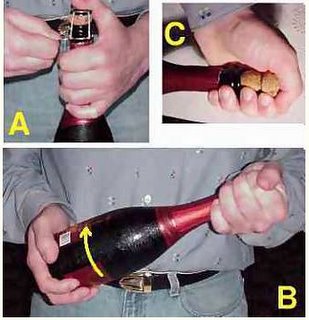
  1. Do hold the bottle obliquely (cradle it in your arm). Don't just open it on a table. Avoid any perpendicular angles created by uncorking it on a desktop or a computer workstation.

  2. Don't point the bottle at anyone. And for heaven's sakes, if you are lining up your glasses getting ready to taste the goods, be aware of yourself: don't interfere with the person opening the bottle and if that person is standing directly above you, duck! (Everyone in the immediate area of the bottle should be cautious and careful. Contents are under pressure!)

Once your sparkling wine is open you can let the party start and forget all your worries.

As instructive as this photo is, I have to say that there's something to its composition that I really like. Things kind of radiate out wildly from the razzle-dazzle of the bright white flash in the centre of the photo, but beyond this foreground there's a strong almost soothing symmetry forming out of the office-space architecture. The oxymoron that is the phrase "office party" is perfectly captured in this moment (And I love how the image within the image is captured in the screen of the ditigal camera at bottom right). Best of all for winebloggers, the release of the cork from the champagne has been clearly depicted as merely nudged out of place -- gently coaxed out and emitting the faintest whiff of a noise, like that of a granny passing wind during high tea, or so said the sound that professionals strive for.

As for yesterday's quote that led to this post: "The only time it's okay to open champagne at room temperature is when the room temperature is 35 degrees"... I'm not sure who said this. What is for certain is that you make absolutely sure to measure those degrees in Fahrenheit, not Celsius. Popping a Krug in the steam room is never a good idea.

20060221

Chilled to the bone (Gelée jusqu’à l’os)

champagne wishes and dreams important rules for sparkling wine and chilling temperature What do you do when you are in a fancy restaurant and your waiter opens your Crémant de Bourgogne all over your table, sending spurts of fizzy wine up and around you like a champion Daytona 500 racecar driver? Question his professionalism perhaps. And then ask the sommelier about how he can compensate you. It's a different story in a BYOW (Bring Your Own Wine) resto, like at Montreal's À l'os, for instance. In a place like that, you are your own sommelier. That means you are responsible for how the wine has been stored and prepared for serving. So when the server asks to uncork for you the sparkling wine that's sitting on your table he should really be offered danger pay. You've brought along this pressurized weapon with you; he can have no idea what he's getting himself into... SPLOOOSH!

A loss at À l'os.

We should have seen it coming but we didn't. That's because À l'os has a reputation for being the wine enthusiast's premier BYO location. They want you to think that you can trust leaving it all up to them.

In some of Montreal's BYO venues, you might cringe when you see your eager server manhandling your Vouvray. You might wonder what on the menu is as sophisticated as the vintage you bought with you for dinner. Not so, at À l'os. But wait. Why is the are puddle of bubbly on their floor? Why did we almost lose a third of our prized wine? Just moments after stepping into the place for first time, I felt a bit betrayed. This isn't what the scene is supposed to be like in here.

steps instructions on how to open a bottle of champagne or sparkling wineMy friends nearest to where our waiter attempted to get a handle on our Prestige Moingeon Brut Crémant de Bourgogne, claim the bottle must've been volatile -- it was prepared for opening correctly and the technique the waiter used was sound: bottle cradled at an oblique angle, stopper gently nudged out of position, rendering only a faint release of air. By the time I looked over to the action, the bottle was perpendicular on the table and starting to froth uncontrollably. What a way to start the evening, I thought. And to boot, after all the commotion cleared, our table reset and the mess mopped up, we toasted our sparkling to find that it was already a shade too warm. DOIIING!

Light bulb! On a frigid night when it was minus 20 degrees Celsius (without the windchill factor), everything had seemed so thoroughly chilled to the bone. How could anything, let alone the wine that had been chilling in the fridge for several hours, get into the place with any warmth at all? I mean, picture it: There were the four of us, who had clamoured into the bistro rubbing our hands together; our drafty table, which was situated a little too close to an external door; the bottle of sparkling wine, which was icy cold to the touch.

But not cold enough. That heavy glass of the champagne bottle was hiding some wine that was above 7 degrees Celsius. And it was not happy! Violent, explosive, and too warm. On this night, who could've known? Not our waiter, who professionally handled the situation, and not us, still applying friction on the dinner napkins laid on our laps in a quest for warmth. But will we know better for next time, lest our brains freeze solid.

Let this be a lesson:

"Make Sure the Champagne is Cold ... Start off by chilling the bottle. The best serving temperature is around 45° Fahrenheit, that would be about 7° Celsius. If you put your hand on the bottle it should feel very cold not just cool. It's important to have a chilled liquid. Champagne that is too warm will foam and spill when you uncork the bottle. You'll lose some of the bubbly and make a mess." www.chiff.com/a/open-champagne.htm

"Temperature variations should be avoided and the bottles should not be moved. Before serving Champagne or Sparkling wine they need to be chilled. Not only will the champagne taste better cool, it will also foam less when opened. Ideally four to five hours of refrigeration is needed. Once opened it should be put on ice." www.thatsthespirit.com/en/drinks/articles/champagne.asp

"The procedure of opening a bottle of sparkling wine ... It is essential to keep the bottle oblique during the entire operation in order to prevent any possible spillage of wine because of the internal pressure. However this may happen in case the bottle is being opened when it is kept in vertical position or when its temperature is too warm or in case the bottle was energetically shaken." www.diwinetaste.com/dwt/en2002116.php