Facebook!

Twitter

Tumblr


Showing posts with label NIAGARA. Show all posts

20070411

WBW #32 Regular vs. Reserve: Hillebrand's Harvest Cabernet-Merlot vs. Trius Red 2004

After missing the last installment of WBW because of technical difficulties, I found myself on vacation for WBW 32 (Guess what readers? WBW 33 is going to be on MY schedule since I'm hosting -- hope you'll perticipate with me in May).

Anyhow, despite being on vacation for the last 12 days, I managed to get an entry ready for WBW 32. At the time I prepared it I thought did some good scrambling and interesting blogging. But there is a but. I will wait to broach it at the end of this post.

The folks at the Wine Cask came up with a keen idea for today's event. It took a little extra time and effort: open two wines that in some way have a regular/reserve relationship with each other. The big brother and the baby brother, as I like to call them.

I found two Niagara Peninsula wines that suited this challenge. (After all, I was in Niagara for part of my vacation.) Rather than regular/reserve, they were basic brand/higher-end brand. An entry-level Bordeaux-style wine from Hillebrand Estates Winery and a fairly similarly styled effort issued under the winery's more prestigious label called Trius. (Trius is a name developed and owned by Hillebrand, so these sibling bottles go out of their way to look strikingly different. Happens in almost every family these days.)

But it doesn't matter how they look. These two are the same vintage, made of the same grapes, and produced by the same winemaking team. The only significant difference we got here is price. Or roughly $10-15 for the Harvest (depending on where you buy it), compared to $20.15 for the Trius.

Or least that's the only significant difference until they are tasted.

Hillebrand Estates Harvest Cabernet-Merlot 2004: quite woody, deserves some mellowing to bring forward its nice Cabernet Sauvignon imprint. Overall is thin but just fine with a Sunday dinner of roast beef, with roasted potatoes and carrots and mashed acorn squash.

Hillebrand Estates Trius Red 2004: fruitier with loads of red berries and a pinch of vanilla, immediately convinces as a more integrated Cabernet-Merlot blend. Fine tannins, nice length and structure. Like the Harvest it is drink now. Spicy notes and cedar contribute to its profile too, making it perfect for barbecue fare. We had seared strip loin in mushrooms and shallots, with caramelized zucchini coins and buttered potatoes with chives.

I preferred the upscale version, and furthermore, its more expensive combination of Cabernet Sauvignon, Cabernet Franc and Merlot was to me a better value. For as little as $5 more, you are getting a lot more elegance.

A successful and worthwhile exercise! But I warned you that there was a but. I found a photo of Trius readily available online so I went back to the Harvest bottle to take my own photographs of it. Suddenly I see the fine print on the label, which says the wine was cellared in Canada. Beware all you Ontario wine drinkers of the dreaded "Cellared in Canada" line. (Click on the photo at top left to enlarge the label). This cellaring business means that the grapes are partially or almost all imported!

I can't believe I played by the rules all the way for WBW 32 only to now find that I've basically been comparing cheap Chilean grapes to "VQA" Niagara harvests. VQA is a seal of quality that guarantees the origin of the grapes as Canadian. I should've been more careful to look for the VQA seal but I guess I was too preoccupied with all the other WBW criteria to notice. What a mistake! Hopefully, this post can serve some purpose to others (and maybe help convince Niagara wineries that imported grapes aren't measuring up to the real thing anyway!)

20070319

Fifty-dollar Franc: Hillebrand Estates Showcase Glenlake Vineyard 2000

cabernet franc ontario varietal groux wine 2000 glenlake vineyard showcase label hillebrand estate wineryI had the luck to upgrade to this expensive bottle when my Hillebrand thirty-dollar-something was tainted. I took it back to the winery's shop and in exchange I received this gem. (Click image for product info.)

Okay, it's not cheap. But it's proof that Ontario can produce some very strong international wine. Credit the fantastic winemaker J. L. Groux, now making wines for Stratus, which is another Niagara Peninsula winery just down the street from the Hillebrand Estates Winery. Groux is getting a bigger and bigger reputation with each passing day and I consider myself lucky to have some of his best Glenlake years, which is where this bottle is coming from. I don't think it's outside the range of a good Saint-Émilion, either in terms of quality or in terms of price.

Both sides hate the comparison though, so here are my notes, straight-ahead.

The Hillebrand Estates Showcase Cabernet Franc Glenlake Vineyard 2000 has a light magenta colour. (At this point, I worried about whether this bottle was past its design life as several winos forecast 2008 as a definite best-before expiration. That's just my nerves though.)

On the nose there were beautiful musky and mellow tones. The bouquet is so alluring that I wanted to return to it even after my first sip. You could bask in it. With repeated sniffs I picked up confit of fig. Yummy.

This was reflected in my first taste. It's noticeably supple and rich in the mouth. You could sense the age on this wine. On the palate I found both a typically leafy and a more unique vegetal profile. Yes, it was partly characteristic green pepper but also a fantastic combination of pithy tomato and stewed vegetables. There was some vanilla too, and since the wine was peaking and potentially fading, it threatened to round off the wine's acidity as I drank. But it did not gradually take over as the night wore on. The edges stayed on and the wine was admirably cohesive.

This Glenlake Showcase was not all that long on the finish. Neverthelss, the wine was well served by food. I chose pungent but profiled flavours to embrace the wine rather than strong-arm it. I came up with a dish scented with fresh rosemary and delicious packed tuna in 100% olive oil all tossed together with three-colour pasta. Homemade toasted thyme pita with some melted cheese also played to the strengths of this wine.

Despite the successful match to light meal like this, the wine went with saucier red meat the following night and it also complemented the wine. But perhaps that's why I love a good Cabernet Franc. It's such a wonderful wine to have on the dinner table.

Click the images below for full details on the bottle label.

20051229

Peller Estates makes my favourite wine of the year

Peller Estates Cuvée Niagara Brut favourite favorite wine of the year 2005
Put the little-known Peller Estates Cuvée Niagara Brut at the top of your year-end best-of list. And then put it at the top of your shopping list for tomorrow. You can get a case of it for not much over $100 (and that is Canadian dollars). You could try to hang on to your purchase and open a bottle each month of 2006 but I warn that you might sooner pop open the entire case before the clock strikes twelve this final weekend of 2005. It's that good. With a bargain price, I have no qualms naming it my top choice of the year.

This sparkling wine made predominantly of Chardonnay grapes is on shelves at the LCBO or at the one hundred or so kiosks of Vineyards Estate Wines which are found throughout Southern Ontario. If you are in Niagara-on-the-Lake, you can also pick it up at Wine Country Vintners (scroll down) on Queen Street; go online to Wine Country at Home if you are a bit further afield and want it delivered (sorry, you must have an Ontario address for shipping). In an odd twist, you can find the bottle virtually everywhere in the Niagara region except the Peller Estates Winery. It is a confusing move of Peller's not to stock it. Instead, their image-generating sparkling wine called Cristalle, $30, with its dosage of icewine is what the winery chooses to showcase in their boutique and during their tours. I don't know why -- their modest Brut is simply better.

When I conducted a quick poll tonight at dinner no one could guess that this calibre of wine is sold for as little as it is. Tasters' comments were all positive, both when I served it alone and then with Paris toasts with cheese and chives. My parents agreed that it was fruity, crisp and nice and refreshing going down. My sister remarked on its bouquet -- alluring, herbal and enriched with a gamut of pleasing flavours, none of which bordered on bitter. Her boyfriend had the final say. It was the length of its lingering finish that made the cuvée so delicious. And what makes it number 1 in my books is $9.95 (that's about $8.55 to folks from south of the border).

20051223

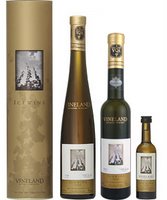
Vineland Estates' Vidal icewine and select late harvest

Vidal Select Late Harvest icewine ontario vineland estates winery
Vineland Estates Winery is nestled along one of the most gently rolling slopes of the Niagara Escarpment. With a view of Lake Ontario below its low hills to the north and rich undulating vineyards sprawling around in every direction, it's not surprising how much tourist business it attracts. During my first visit, the 2000 Red Meritage -- a benchmarked Bordeaux assemblage with a $125 price tag -- drew most of my attention. Today I was able to concentrate on their icewines. Currently composed solely of Vidal grapes, Vineland Estates' speciality wines include a new Late Harvest as well as two icewines, one from 2002 and another one recently released as their 2004 vintage.

I started with the 2004 Vidal Select Late Harvest (just released and not pictured above). It's a bracing concoction with notable acid and strong citrus flavours. Its silky texture reminded me of the lemon-lime syrup at the soda fountain: crimp the hose that dispenses the carbonated soda and you double up on the concentrated sweet stuff. But that's not to say that the 2004 is too sweet. It's grounded by that palpable acid and real nice note of butter. Great.

For the 2002 Vidal Icewine (pictured third from left), hints of syrup flow like divine nectar. It has more honey than the Late Harvest -- a delicious sweetness that suggests pear or that juice you get in fruit salad. It has great balance in its rounded attack. I was able to linger over a few small portions of this wonderful treat since I had just finished a full plate of lunch. A full stomach is not factor because of the alcohol content, which is low (around 9% for each of these three bottles), but rather for the richness and intensity of this golden exilir.

On to the 2004 Vidal Icewine (pictured first): I immediately sensed a bigger "throat feel". It's what I would describe as a puckering tannin effect that you get as the icewine goes down. For me, the 2004 icewine offers more than I am apt to take. It was at this point that I wished I had some of Riesling icewine that had kicked off my 2005 almost a year ago now.

It would be remiss of me not to mention that the Vidal has been good to Vineland Estates, garnering many accolades including the Grand Vinitaly Award. Aside from that, Vidal icewine is more commonly produced by Ontario vintners than Riesling icewine and is generally more affordable too. And for that reason I would heartily recommend any of these wines. I think that in particular the 2004 Select Late Harvest and the 2002 Vidal Icewine, which is priced in Quebec a few dollars cheaper than it is in Ontario (yes, it does happen!) are both wise selections.

Finally, John arranged these wines for me. Thanks to him for the suggestion. This flight is the first one that Doktor Weingolb has taken, so it only seems perfectly suitable that eiswein be the feature.