Facebook!

Twitter

Tumblr


Showing posts with label PAIRINGS. Show all posts

20071123

What bottle of wine backs up your meal?


How many people have asked the question: What wine do I serve with dinner? The photo above always comes to my mind when I hear this question. In fact, I should mount this photo onto a flash card and hand it out to anyone who asks. That's because it so perfectly demonstrates the answer to the question (and also because this photo literally depicts a wine bottle hidden behind the food -- you can only see the bottle neck peeking out).

So what bottle of wine backs up this meal? What wine is behind the dish? In order to answer, you've first got to determine what it is you're eating.

Well, that's easy. It's grilled salmon.


Fish = white wine. Problem solved. Push aside the red wine. Let's eat.

But wait! It's not actually fish -- that's really a chicken breast.


So slide the red wine over back over. Roasted chicken = red wine. Dig in!

And suddenly, the gustatory experience of your dinner has been reduced to easy visuals rather than tastebuds and mouthfeel. Any black-and-white answer to the pairing wine with dinner question becomes, at best, a dubious conclusion. My flash card has no clear answer written on the back. Because grilled salmon goes with red wine and white wine; roasted chicken goes with red wine and white wine.

KILLING THIS NEW WINE TREND BEFORE IT IS BORN

Around Halloweentime, Dr. Debs at Good Wine Under $20 spoke out, unearthing a spooky post. Very spooky!

In it, the wine bottles we typically see at our shops are talked about as if they're in perpetual disguise -- like their labels are masks and wine shoppers who come across them couldn't guess what's behind that mask until they open it, pour it out during dinner, and shockingly find [cue thunder and lightning bolts] that it doesn't complement your food!

Therefore, one proposed solution to this horror scene is a line of wines that have no labels at all, just the image of the food you should serve them with, as illustrated by the bottles above. How clever this is!

If only it worked. Dr. Debs explains the problem well. Kudos to the doctor -- check out the full post.

The way I see it, the problem is that the food you make is dressed up every night of the year, not just on Halloween, or on Thanksgiving. Surely no one prepares the same food the same way every night of year.

Take a look again at the flash-card photo of the dinner I recently made. At first, I couldn't even tell if it was chicken or fish I made that night -- mostly because my grilling preparation method with fresh herbs and bold flavours suits both chicken breast and salmon.

One ends up tasting like salmon and one ends up tasting like chicken. The accompanying flavours and textures always support a good food-friendly red wine. Personally, I think nine times out of 10, I'd reach for red wine after grilling no-matter-what, fish included. That's because the preparation supports flavours and textures that nine red out of ten would handle better than a typical white.

So yes, red wine with fish!

Now that's spooky for a lot of people. But to me, it's the truth. Spooky, but true.

But I'm not going to say that on average reds better suit grilled salmon without serving up readers a good example. Nine reds out of 10 may not totally convince you that red wine and fish match.

Stay tuned for the versatile, food-friendly wine I serve with almost anything -- that'll be the next post. I'll give you a hint: It's not Saumur-Champigny or anything remotely close to the Loire.

20071102

Wine blog and day job, Apollo and Dionysius, rhythm and melody?

Seeing the future from a bottle and the lines are increasingly blurred blurry

My experience wineblogging will occasionally assist my real job, but rarely has my day job ever directly helped out my wineblogging.

But then: this. This morning, a wine article called Music to drink wine by: Vintner insists music can change wine's flavors came right into my inbox at work.

It came to me not because of its stated relationship to wine -- not at all because of that, though in fact several of my colleagues now officially know I'm a wino. Rather, the news story came to me by virtue of it coincidentally mentioning my employer, which really has little to do with the actual story.

And thank goodness for that. Let's just sweep that association under the rug because this is either some whacked-out story about an eccentric winemaker named Clark Smith (pictured below) or the dawn of a new wine trend that's really going to make my head hurt.

Thinking about and taking tasting notes for the wine I drink usually hurts my head enough as it is. You try to keep wine appreciation honest by accurately deciphering aroma and flavour, length and weight and then food pairings come into the equation. All that is quite hard enough without factoring in and figuring out the various cerebral synapses firing that alter your perceptions when drinking. What this report suggests is that you've got to postulate whether a musical selection is going to hurt or hinder your ability to appreciate a particular wine. Well, can't my personal experience just be kept personal and leave it at that?

Not according to this. I won't even try to re-encapsulate it myself...

MUSIC TO DRINK WINE BY
A McGill study is cited in this San Francisco Chronicle article about whether wine tasting requires the same logical processing areas of the brain as listening to music. Research by Anne Blood and Robert Zatorre of McGill in 2001 showed that when subjects listen to music they enjoy, they activate pleasure centers of the brain.

"Smith's premise is that different music makes some wines taste better and others taste worse, and the great majority of tasters will agree with the "right" and "wrong" pairings regardless of their taste in wine or music. Moreover, it's not possible to record a generic "music to drink wine by" CD because a song that might make Pinot Noir taste great can make Cabernet Sauvignon taste awful. You have to pay attention to individual music and wine pairings.

He's only getting started, but he already has made some surprising, counterintuitive discoveries in an area of wine taste-testing that didn't even exist until he created it.
[Hmmm... is this last line delivered with skepticism or celebration?]

(Blood and Zatorre did not respond to a request for comment on Smith's theories.)"
I wonder why the scientists aren't rushing to comment?

I was. I commented before I even could post this entry, which offers the unique opportunity to blockquote myself:
Although Smith makes some attractive ideas salable here (many people, including myself, have likened a wine's elements to musicality), I still felt strangely uncomfortable while reading this. Uncomfortable, until I realized there was a voice of reason at the end of this article that was easy to latch onto: Kermit Lynch's. I don't think I want my brain to know about my brain, especially when I drink wine to kick back and relax!
So the question is: Are the lines that Smith has drawn blurred because of the converging forces affecting the minutiae of our lives which he then tries to scientifically explain away or are those lines just blurry because the guy has drunk himself off his rocker? I ask you.

20071019

Indian Summer: Revisiting San Quirico 2005 (Saint Quinine or "San Chinino")


Indian Summer is beginning in Montreal. Temperatures went up to 18 degrees yesterday and promise to hit 23 degrees today. The weekend and Monday should reach 20 degrees - 10 degrees above normal. When the temps climb so abnormally this late in the year, it's called Indian Summer.

Indian Summers makes me want to drink white wine and I've actually got a more notes on them than the reds lately. I clearly need to clear out from the passing season. First though, another look at San Quirico Vernaccia di San Gimignano 2005 which was my favourite drink of summer.

It's no wonder I wanted to take a long summer Vernaccia when there's wine as refreshing and regenerative as this. In fact, this bottle I got while on vacation in New York over July and August, which explains the label being different from the previous one. It's the same vintage and still is the same wine inside -- that magic combination of fennel and flat ginger ale with a citrus twist.

This wine is usually low in alcohol with a bitterness that only acts to further mask any kind of heat. Very minerally, very wet stone, which I love, but really not vinous at all, which a lot of winos might not like much. It's practically a lemon lime seltzer, but it'd be the most exquisite soda you've had -- something that only New York City seltzer can seem to offer. (How appropriate the NYC connection is because Quebec only sells one single bottle of Vernaccia -- the more inhibited Rocca Delle Macie... I think I've come to associate this wine with New York for its supply as well as the seltzer standpoint.)

In revisiting this wine I deciphered another one of its interesting elements, a characteristic I can only link to quinine, that essential bitter ingredient in tonic water. (I called this wine regenerative -- it's no wonder it's like a tonic!) It kind of makes the sides of your mouth get all dry and pucker in the same way a bitter tannin would. Yet there's no tannins in this wine, and it's not even barreled in wood. So does this wine contain quinine? I can only think of quinine having a similar effect when there's no tannin or wood involved.

But wait! Quinine, it turns out, is actually a little bit of both. But first a bit of history...

Quinine was part of a refreshing beverage that was born of another kind of Indian summer -- summers in India at a time when fighting malaria had a enjoyable treatment and prevention method. Of course I'm talking about gin and tonics. It was the quinine in tonic water that was the effective medicine against malaria then and the story goes that the British and the Indians added gin to their quinine-filled water to reduce quinine's bitterness, hence the birth of the gin and tonic.

Even after other anti-malaria medicine were developed in the 1920s, India kept drinking, becoming the first place where people enjoyed the unique properties of quinine in a non-medicinal way.

So what's the tannic/wood connection to quinine, and perhaps to this wine? Well, although the Indian summer might have been where perfect quinine refreshment was discovered, it was during an Incan summer way back in Peru of 1817 when French scientists harvested bark of the Cinchoa tree in Peru to discover the alkaline organic substance which was known as Quina-Quina by locals. It came to be called quinine, taking the name from what the Incans named the bark -- "holy bark" -- and rightly so because the stuff was a medicinal wonder, though very bitter-tasting. Quinine is tannin. Quinine is wood! Or least a part thereof.

And I find it every bit the perfect coincidence that before quinine was successfully harvested from trees in South America it was originally used as a tonic. This was way back in 1600s where it was found in the swamps around Rome -- not far from San Gimignano, the indigenous home and virtually sole growing area for the vernaccia grape. Hmmm... is this how vernaccia gets its quinine-like profile? In Italy today quinine is known as "Chinino" (and if I want to stretch the connection, this wine is known as "Quirico," a placename that quite similar-sounding, though I have almost zero knowledge of Italian).

But back to the real Quirico here: There's something about the quinine-like edge and lack of vinousness in this wine that makes it special, whatever the chemistry might be.

For instance, this wine is the perfect -- scratch that -- the only wine that can be paired with a salad dressed in vinaigrette. Try Vernaccia with a salad like this and you'll be amazed as I was. It's a match! (Most wine isn't supposed to be paired with any vinegar-based accompaniments, ever.)

recipe for vinaigrette


four teaspoons olive oil
three teaspoons rice vinegar
one teaspoon amontillado sherry or other dry sherry
salt and pepper to taste

Combine ingredients in a small bowl and stir rapidly until emulsified. Pour on washed, spun-dry lettuce or mustard greens in a large salad bowl. Mix to coat thoroughtly using your hands (also washed, but not spun-dry).

20071012

SNAKSHOT: Filet of fish and Quinta de Cabriz Reserva 2003 meet for dinner


This was a fantastic meal prepared by my sister and her boyfriend on April 2, 2007, already a half-year ago but still strongly etched in my mind.

It wasn't Easter dinner but it was a very sophisticated dinner, yet stunningly simple in execution. Lucky me -- I got to watch, and point my camera.

When I arrived for dinner, the strong smell of soy sauce met my nose. In the kitchen, fish fillets were marinating in a baking dish. The aroma was pungent and I got the idea of offering a pairing by way of one the Portuguese wines I brought with me.

The final dinner preparations were made as I nibbled and shared a Cheverny aperatif that I knew would be just my sister's style of wine and it was. I was more apprehensive when it came to selling a sturdy Portuguese Reserva with such a very white fish. But in the end, my Quinta de Cabriz Reserva Dão 2003 made perfect sense since the Portuguese diet is replete with heavily flavoured fish dishes, be they charred, smoked, grilled or broiled.

Our fish went into the salamander under the oven and was cooked to perfection. You can see this in the photo above, and how the tasty marinade worked its way into the fish flesh, generating a big flavour punch to the palate. A punch that my wine could stand up to and flatter as an accompaniment. And yes, even a blood orange garnish wasn't enough to throw off this wine, though you wouldn't except much from pairing a red with some citrus. Yet the signature profile of spice and orange confit in many good Portuguese wines permits this match too.

There was a gasoline-y note in this wine that some might call tarry or mineral. It coats the tongue in a certain way. You know it was you taste it. The assertive treatment for the fish penetrated this effect of the wine and then proceeded to dazzle the tongue with its own "umami" seasoning -- something I don't think my more restrained and elegant wine from WBW 38 would have allowed the food do as well because it is so much softer.

The Cabriz Reserva, which is composed of Alfrocheiro, Touriga Nacional and Tinta Roriz indigenous grape varieties also offered strong berry fruit with palpable acidity to cozy up to the creamy pasta side and make some nice contrasts. But all I can really say is that we lucked out, because this was not only the first time I uncorked this bottle, but the first time I had ever seen it. I bought it at the LCBO moments before I walked through their door.

I love Portuguese wine.

Thanks to those who inspired this post: Ryan and Gabrielle of Catavino who hosted WBW 38 on such a great and ripe topic; Sonadora whose compliments on my dinner photos got me to go over a long-neglected food photo album; BrooklynGuy whose interest in deciphering these red blends put me into a pairing-analysis mood; and finally to Kristen and to John for their totally memorable dinner. It was a treat! Cheers.

20070905

Wine-friendly veggies on demand

vegetarian feast summer picnic ideas for yummy veggies in season
The theme has been summer nostalgia and letting go post-Labour Day weekend. Yesterday, when I admitted that every season has an end, I also came to terms with a too-aged bottle of wine designed to drink young. It was heavy and cloying and a lack of freshness suggested that it had oxidized.

It was one of those sunny and versatile summertime wines, namely the Frescobaldi Albizzia Chardonnay Toscana 2005, and it showed that its limits were as clear and well-defined as summer -- Montreal's shortest and most sudden season. (It turns out that the Albizzia cuvée is very appropriately named for "usually small trees or shrubs with a short lifespan"... just check Wikipedia for the proof.)

That was then, this is now. This post is about the food I often served at wine-curated picnics over the last three months, and it's entirely true that the picnic pictured here featured those Albizzias, so sunny and versatile then, as well as that rosé you see.

What I served is a simple dish, so versatile with wine and yummy on its own, that's been plenty on demand around my place. I've received requests for the recipe in person and on Facebook. So it's about time I quite stalling and fess up: It's roasted vegetables, people. The most amazingly good and amazingly simple food fixing known to man.

Roasted vegetables, antipasto-style


- Choose 1 (or 2) of: cauliflower or broccoli florets, fennel, onion, tomato, mushroom
- Add a generous splash of olive oil and mix to generally coat everything
- Roast in the oven uncovered at 450 F for 20 minutes, stirring once
- Let cool momentarily in mixture of butter, capers and garlic, or instead, fresh mint and salt and pepper
- Serve! And save leftovers for an enjoyable cold lunch

picnictable furnishings outdoor party with food and wine(Note: Cauliflower takes 25 minutes; tomato and mushrooms take 10.)

I hinted in my last post that this kind of recipe would fade in the weeks to come but I don't believe it now. For one thing, I would drink pretty much any wine with this other than your most delicate whites and most tannic reds. On top of that, hardy vegetables continue to be plentiful into the fall and the heat your oven gives off to make this dish only becomes more pleasing as the days shorten. Plus, as I look ahead to the short-term weather forecast, I see that the first Thursday, Friday and Saturday of September are scheduled to be summer's most formidable heat wave. It's summertime again. Get picnicking.

TASTY MORSELS

My Italian wine over-consumption two weeks ago when I was a tasting panelist has paid lovely dividends. I figure nicely in Bill Zacharkiw's latest column on the (Montreal) Gazette's Wine with Bill Zacharkiw website. Check out the site -- it's growing rapidly as Bill's tenure takes off since replacing veteran critic at the newspaper Malcolm Anderson -- but also note this direct link to the goods I helped sample: Valpolicella Classico, Ripasso, and Amarone wines.

It's been said about Bill before but let me say it again: no one has the know-how and the knack for identifying a wine's key attributes and instantly matching them up in appropriate food pairings. His writing readily conveys this, so it is a joy to read his reviews, which are totally mouthwatering and score-free to boot.

20070520

The spirit of Languedoc-Roussillon value wines: L'Esprit de Château Capendu & Domaine Borie de Maurel Esprit d'Automne 2005

[L'Esprit de WBW 33 Langudoc-Roussillon : L'Esprit de Château Capendu et Borie de Maurel Esprit d'Automne 2005]

spirit wines of languedoc roussillon wine blogging wednesday 33 festive dinner to celebrate may's themeWBW READERS' NOTE: The round-up for WBW 33: Languedoc-Roussillon value wines, Mid-priced wines from the Midi, is just around the corner. While I finish tallying up the entries posted by participants, here's a post about how I found the "spirit" of this edition of Wine Blogging Wednesday when I happened to uncork for dinner guests two unrelated Languedoc-Roussillon wines that were both given the name Esprit. (Esprit is the French word for spirit.)

L'Esprit de Château Capendu Corbières 2005 et Borie de Maurel Esprit d'Automne Minervois 2005 toasts nut bread french foie gras from quebec perigordThere's something about all things French that ooze Frenchness. I guess what I'm trying to say is that the French seem to take a lot of pride in their culture. One way this is clear is in how they name things.
French products -- whether they be cheese, knives or whatever -- are bestowed the name of their origin. This placename then becomes how the product is referred to, from far and wide to nearby towns. Roquefort, Laguiole, and so forth.

The best example for me to illustrate this is, of course, wine. As we saw in WBW 33, French wine is designated almost always by origin (French table wine is an exception) and France's robust appellation system (AOC) ensures that how a wine is named is where a wine gets made: Champagne is produced in Champagne. Et violà!

You can see naming by place throughout the wine world in geographic designations or "appellations" (appeler is the verb to call or name). This act of official naming sanctions wine based on its origins, which seems to make sense, especially for viticulture. What about for agriculture and other food production?

On a weekend not too long ago, amid my preparations for WBW 33, I hosted a dinner featuring garlicky roasted pork tenderloin, grilled eggplant and oven-baked potatoes with fresh herbs. I paired it with -- what else? -- Languedoc-Roussillon wines. My menu was generic French cooking loosely based on Languedoc flora and fauna. I didn't really realize that plenty of French food items also come with its share of placenaming.

I haven't heard of anything on a dinner menu named Corbières or Minervois -- those seem to be strictly wine names. But then a thoughtful dinner guest showed up with almost a direct placename connection between Midi dish and bottle. Eric came bearing a tin of foie gras. We peeled it open, uncorked the wines, and tasted (as shown in picture above). Delicious indeed.

What exactly was the connection? It wasn't totally apparent at the time. The next day I realized that the foie gras we ate was produced by Élevages Périgord. Sure, foie gras is a very French dish so it seemed a natural for a meal featuring French wines. But the connection went deeper than that.

FOOD AND WINE'S ULTIMATE PAIRING

Périgord itself is a placename -- a province in the Southwest of France near Bergerac that has claims to the legacy of foie gras. Though this Canadian farming enterprise called Élevages Périgord is clearly "borrowing" that legacy by taking on the name, the product actually incorporates real French ducks (see Élevages Périgord link). This means that we theoretically could've been eating ducks that once waddled by vines which grew the fruit that produced the wines we drank. I know all wine and food have a natural dynamic together but clearly this is synergy!

No one at my dinner could say for sure that strictly local ducks made this course so perfect for our Midi wines. Origin may have made no difference in the end. But I think we were okay with that. The pairing still had flair and the whole idea carried that characteristic French sense of pride, often routed in a strong sense of place and decorum, which often garners the French a bad rap for perhaps the wrong reasons.

Thinking about my Languedoc dinner now, I can imagine a butcher located up the street from a winemaker -- the butcher gets residual business every time a local bottle of red wine is sold, and when someone asks him what to serve with his pâtés, I can picture him pointing and saying it would be the wines produced just down his street.

P.S.: Anyone interested in the "perfect" wine-food match based on origin might want to try a Périgord delicacy with some of its local Monbazillac wines. Foie gras is best served with rich wine and Monbazillac is the Southwest's version of Sauternes from Bordeaux (or you could say a version of the Midi's fortified wines) so the pairing aligns itself well at many levels.

20070302

SNAKSHOT


fillet of pork tenderloin charcutiere fresh deli sauce broccoli grelot potatoes with rosemary
This is one of my standby meals when pork filets go on sale. It's from Jacques Pépin's Table, which I think was my first cookbook. Pépin does it all in this book, not only supplying heaps of great recipes but combining the individual dishes into menus to which he suits specific wines. If you can't find a copy in print, here's the webpage with the recipe for Filet of Pork Charcutière.

(In my experience, the flavours are so forward in this dish that chasing after some of the specific ingredients he lists is unnecessary. Use any onion, though red onion is a treat, and frankly, the white wine is not essential. Pickles, tomatoes and Tabasco are the integral components.)

I doubt Pépin makes even one suggestion for a Douro, a Dão or an Alentejo in the entire cookbook, but that's what I've got decanted in the pitcher above. After reading over his notes, a red from Portugal makes even more sense now than when I served it. The deli-style sauce is acidic so you need wine that won't turn to flab by comparison. I hate to say it, but no effing Merlot. A Barbera, or another rustic Italian red might work nicely but I think a lusty red from Portugal is ideal.

20070222

SNAKSHOT


portabello mushrooms four-cheese pasta roasted red peppers parsley tricolor
Red, white and green makes Il Tricolore, also known as the flag of Italy. (No disrespect to Mark Rothko but red, white and brown is not quite as appetizing a colour combination, though it does make for an attractive rectangle in its own right.)

I have no clue whether the culinary legacies of Italy contributed to the creation of their national colours. I'm not even sure I was attempting Italian cooking when I had these roasted red peppers spill over four-cheese pasta and grilled portabello mushrooms on parsley.

What I can say is that this meal is incredibly flexible. It seems adaptable to any of the three wines I talked about in yesterday's post: Red, white and pink. The hearty mushrooms take the place traditionally held by red meat, but don't demand a red wine to match. The pasta is rich enough to take on a red wine but nuanced enough to pair with white. If I added leftover chucks of cooked ham to the pasta like I did recently, it, whether served hot or cold, would be delightful with a rosé. The peppers -- which I have heard called difficult to match -- were very sweet and equally easy-going as the rest of the plate. So pick your favourite wine (...or should I just say give a colour a tri).

20070213

SNAKSHOT


ham steaks balsamic mesquite glaze grilled radicchio cheese pasta basil grape tomatoes

I'm really not trying to be hokey or cliché posting this soft-focus scene and then a suggesting Champagne as a match for it. I know that it's practically Valentine's Day and I don't want to sound contrived but a slightly spicy glaze slathered on ham steaks accompanied by a rich and cheesy pasta and dotted with juicy and basil-y sweet whole grape tomatoes? You're going to open some Champagne or other fine dry sparkling wine. Screw romance though. It's to set off the dinner. What may or may not happen with the diners is for another blog to get into.

When it's hard to pair red wine (or even white for that matter) with a certain foods, just pop open some bubbly... With the teeming market-fresh flavours shown above, I might recommend a vintage pink Champagne in particular, say, the Louis Roederer Brut Rosé 1999 but really anything goes. Fizz is the renowned safe bet for a bottle you can uncork at any meal.

20070205

Snakshot part deux: Après-poulet

après snakshot organic local grain-fed chicken saint vincent montreal jean talon market quebec brussel sprouts basmati brown rice green peasIn the world of food and wine pairings, the chicken breast is like that kid who plays right field in pick-up baseball. He'll contribute but certainly not play a starring role. By the end of the evening, he'll get the job done and little more than that.

Unless that chicken breast is from a flavourful grain-fed roasted bird. Yum. Then you can tell the difference a local organic chicken makes. You're not out in right field anymore, that's for sure.

The following are scenes from that delicious whole bird, post-incision. Feast your eyes. Like the chicken, the Brussels sprouts were grown in Quebec too. I'm spoiled now. Spoil yourself too. Enjoy it with anything but a run-of-the-mill wine.

Enate Somontano Chardonnay 234 2004Based on comments left on this site's last chicken entry, it's the wine that helped wash down this chicken that people really want to talk about. I had half a breast and half a leg with the 2005 Pastiche from Joseph Phelps. This Californian red table wine is unlike any other I've tried and was perfect for a whole roasted chicken like the one we ate. Its New World take on the wines of Old is definitely worth noting and I will be integrating it into my post for Wine Blogging Wednesday #30 (which, by the way, is on February 7 -- already upon us -- and the topic is a juicy one: New World Syrah/Shiraz.)

We actually opened a Spanish Chardonnay first, but it was mostly gone by the time the chicken was done. Chardonnays aren't a bad idea either for roast chicken. The Enate Somontano Chardonnay "234" 2004, though nicely bodied and slightly nutty, was not oaky though; an interesting Arbois take on Chardonnay, such as a Savignan-Chardonnay blend or, for the initiated like the Montreal's very-own Caveman, a full-on Savignan, is a perfect fit.

Savignan with dinner... definitely don't expect any right-field boredom there.

Who else has got a favourite organic product? Or favourite organic food supplier where they love to shop?

20070201

SNAKSHOT


roast chicken or the egg organic grain fed jean talon butcher saint vincent
"Chicken puzzle" ... What came first, the chicken or the egg? A good question and one that is readily conjured by the image shown above.

But when I took this photograph that wasn't exactly what I had on my mind. I was getting ready to open a bottle of wine to have with dinner. Roasted organic chicken, locally raised and grain fed, is a cut above your everyday hen. My friend Eric gets his whole fresh chickens from a local butcher set up at the Jean-Talon Market. And then he prepares his birds using a simple yet elegant Jacques Pépin recipe. The results easily demand one of your better Rhône reds or a good Pinot Noir.

Puzzle solved.

20070115

SNAKSHOT


Yummy fresh lamb on a tossed green salad may not seem like the kind of dish you'd have on winter-raging day like today is in the province of Quebec. But when paired with a heart-warming Bordeaux, a spring dish can easily become a meal fit for winter's day. It's also good fuel for tomorrow's much-anticipated start to the ski season.

20070104

SNAKSHOT


isha tan truffles chocolate

In case it hasn't hit home with you yet, TruffleMania 2006 is indeed over.

But why not take a moment to brush up on what wine you should open next time you've got a plethora of fine chocolate on hand?

20061127

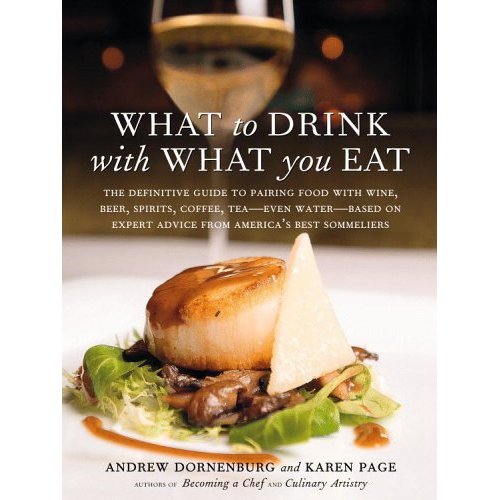
What I think of "What to Drink With What You Eat"

I missed posting this on Buy Nothing Day. Now I fear I may be too late.

If anyone gets me the most pretentious book of the year for Christmas -- a encyclopedic dining guide called What to Drink With What You Eat by Andrew Dornenburg and Karen Page -- what to stuff in what you hang by the chimney will surely be a BIG FAT PIECE OF COAL. Why?

Well, there's the wino's angle on it and then there's the foodie's angle on it.

But first I think I need to explain something since every review I've encountered online has been balls-to-the-wall enthusiasm for this book. That I need to explain this is surprising to me because I thought what I am about to say is obvious. Here goes...

The reason folks need guidelines on pairings is precisely as follows: you've got one shot at that bottle and one shot only. You don't want to screw it up by pairing a vintage Brut Champagne with dessert. And so you turn to someone who can tell you how to get your money's worth out of it.

If you need instruction when pairing a frappuccino or some other $2 beverage from Starbucks, then clearly you're missing this point. You could dump the thing over your head and still come close to getting your money's worth. Yet this new book, WTDWWYE for short, seems to get off on recommending pairings for every drink you can think of right down to tap water. That's either silly or pretentious, or both.

If you want to pair your ciders, your juices, your bottled waters, I say go ahead. But you're kind of on your own, aren't you? I mean, there are no established guidelines for you to follow -- and there's certainly no demand to decode something so pedestrian and commonplace -- so you have to rely on your palate to guide you. But that's perfectly okay because those who follow their palate find that trial and error is a viable option for coffee, tea, water and what-have-you. (Whereas "trial and error" and Krug have never appeared in the same sentence. Ever!)

karyn paige andy dorenberg food and wine pairing bookTrial and error pairing is folly when you finally make that soufflé that doesn't sink and you really want to celebrate it in style. Like a fine wine, you've created something rare, and by god, you hope someone's been so kind to advise you how to do it justice (that Cabernet you're fingering is not the best idea -- a fate worse than falling for any soufflé). In this regard, WTDWWYE does an admirable job. It provides matches for a large array of different soufflés. It doesn't have every food under the sun -- no merguez or lamb sausage for instance -- but at least it scrapes by with entries like "Moroccan cuisine".

But that's pretty much where the instructiveness of food matching ends. Telling someone to have Evian with their veal meatballs isn't instructive as much as it's annoying. Telling someone to open a bottle for their fast-food taco is just bizarre.

In this way, WTDWWYE's approach of "we must achieve more than the sum of the parts" to every pairing gets ridiculous real fast. The catchphrase they use is 1 + 1 = 3 but no matter how often it's repeated to me it meets resistance. I think McDonald's Big Mac + any wine in the world = nothing more than a -5, not a +3 as the authors suggest. But Big Mac lovers will disagree with me. Perhaps they should buy this book.

Fast food mentions aside, WTDWWYE does deal with a lot of real food and a lot of wine. It comes at each separately: at the front, food entries are given a list of matching drinks, all supplied by culinary experts, after which beverages get their expert-generated list of pairable foods.

THE WINO'S ANGLE

Here is where the wines that readers like me have been husbanding for that special moment of culinary bliss come to the fore. I turn to Andrew and Karen and ask for advice. In response, I get a mixed bag of interesting tidbits. Personally, I find there to be too many vagaries and the stringing out of list upon list, all of them dancing around the attractive idea of finding common rules for the book's pseudo-science.

The authors get real close to securing some of these common rules at the start of the wine-based section. The clever bits contained under "By Type of Wine" is very interesting and infinitely useful. It spells out the truest and most scientific guidelines for wine matching and arranges ideas by attribute, i.e. acidic wines, tannic wines, etc. But it's only three pages and barely scratches the surface. Then the bigger 75-page "By Name of Beverage" segment begins which is only as successful as it is misguided.

What really bothers me is this guide claims to be a "definitive" source on pairings. Definitive is a big word for such a tenuous science and such a relatively small reference book. There's certainly nothing definitive about wine pairings when entries are grouped by varietal, as they are here. The authors of this book have heard of terroir and as a result some wine regions -- mostly French and broad -- are covered. Occasionally an effort is made to specify California Cabernet and Merlots. The cynic in me suspects that this only serves to better placate their key demographic.

Me, I don't drink much American wine so I first tried looking up what I had already opened from the previous night: A Minervois. There was no listing for it.

Then I tried looking for what I had on hand and was ready to drink: Coteaux du Languedoc. No listing. Not even a mention for any Languedoc wine, perhaps the biggest up-and-coming wine region in the world.

Then I dialed it back a bit and went flipping through the pages for a varietal wine. Though virtually all of my wine cellar makes no mention of grape variety as Old World wines seldom do, a knowledgeable drinker could figure it out. But that's a high-maintenance condition to using WTDWWYE. I just pretended I had a Viognier to crack open, since I recently had one that I really enjoyed. Under Viognier, the first item listed was appetizer. This is less than instructive. Mini-quiche? Pig in a blanket? Breaded shrimp? Cheeseball? What!?

The rest of the list painted a better picture for pairing Viognier. But I have to wonder about what the expert who submitted this particular response was thinking. Either the expert had more to say and the authors left it unsaid (which unfortunately is by design since all the expert-supplied entries are in strict list format) or the expert is masking his or her expertise by being imprecise. In either case, what good do the authors think these vague entries are doing?

Then I moved away from wine and investigated some of the oddities in the previous section organized by food item.

THE FOODIE'S ANGLE

I'm a home cook who owns a tiny cellar's worth of wine. The entries filed in this book aren't brimming with the practical tips they are purported to have for people like me. Strategic tips is more like it. These are strategies that trendy restaurant sommeliers, B&B owners, or program directors at wine resorts would likely use since they are expected to have crib notes for everything they serve. For the everyday chef, it seems like a heaping serving of pedantry.

The book is impractical for other reasons too. For instance, if this book had been written for me a lot of the lists would be left blank. What to drink with Oreo cookies. NOTHING. What to drink with Kumquats. NOTHING. What to drink with Ketchup. NOTHING. What to drink with Epazote. What the heck is Epazote? I don't eat any of these things so I'm certainly not going to uncork a bottle for them!

It's all a bit unnerving. Never has the rigorous employment of weights and measures seemed more like the devil's work. The authors have even deciphered what Spring pairs well with, as have they for Late Afternoon. Indian Summer, February 29th, and Summer Solstice are in there too I'm sure. Missing is what to drink for Coffee Breaks and Teatime.

And so the book arcs from whimsy to the shockingly obvious:

Scones: tea, esp. English Breakfast...
Éclair, chocolate: coffee, medium to dark roast
And then back again to the reverse mapping:
Coffee, in general: apple pies and tarts; breakfast dishes, esp. wheat-based; brunch dishes, esp. wheat based.
Passages like these that make one wonder if there could be a better job than doing this guide and getting paid by the word.

By the time I got to reading up on individual spices, I realized this book can be taken too literally. Marjoram is a white wine spice but oregano is a red wine spice. Fennel, white; rosemary, red. Coriander, white; thyme, red. As this rate, I'll be serving rosé with every bloody meal I cook. The herbes de Provence I use almost nightly is turning out to be a real nightmare lurking in the spice drawer.

But if this part of the book is frequently frustrating, the section on cheese is done well -- admirably inclusive and quite instructive.

I'm sure there are some other lists I would use and maybe even consult frequently, but my feeling is there's not much here that you couldn't get from a two-second google. And besides, when you google "McDonald's Filet-O-Fish + wine pairing" the results you get back are supposed to be funny.

20061002

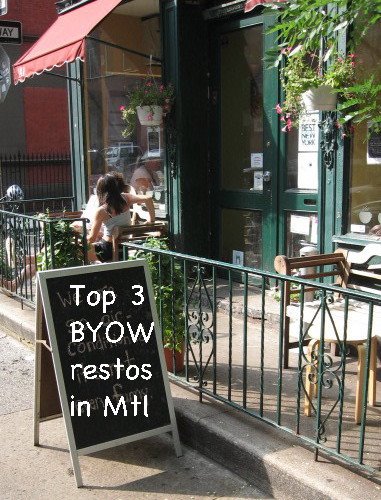
Favourite BYOW Restaurants in Montreal

list of best restaurants montreal byow les meilleurs restaurants sur le plateau format apportez votre vin à MontréalWho wrote "Top 3 restos" on that ardoise (that's French for blackboard) propped up over there?

The establishments I'm about to profile are indeed at the top of my list -- and should be on yours -- but there are so many great bring your own wine restaurants in Montreal that I'll hold back from calling them the Top 3 or the best in the city. In these Jan Wong'ed times, a contention like that calls for some serious journalistic research to back it up.

No broad strokes here.

No extensive study either. It's just that when I go out to eat I almost always choose one of the city's plethora of BYOW options. So suffice to say that the restaurants mentioned below have been consistently good over the past years, always quite affordable, and I can't ever remember not enjoying myself over the course of repeated visits and various food orders.

Here are my "favourite" three places to bring a bottle to (all you out-of-towners should remember that Montreal's BYOW scene is strictly corkage-fee-free, another big plus!)...

Note: Restaurants are listed below are in no particular order.

  1. Pizzeria Napoletana

    In the heart of Little Italy, there is real authentic pizza -- the best I have had in the city. The Napoletana menu also includes pastas and salads but most folks order themselves one of the thirty-something different four-slice pizzas. Check out the full menu on Napoletana's new web site. Extremely noisy room, no reservations taken, cash only and don't even think of asking for a wine bucket, but despite all that this pizzeria still is a must-visit BYOW resto because it has reliably got the best plates at the lowest prices. There are two SAQ outlets selling copious amounts of Italian wine that are quite close by: St. Laurent, corner Danté or Marché Jean-Talon North. Go for a Rocca Delle Macie Vernaiolo Chianti (the 2004 is delicious) which, at $13-and-change, will cost about as much as your pizza. Share both with friends.


  2. La Raclette

    It's less noisy than the above, but no less colourful or fun. La Raclette is a wonderful neigbourhood restaurant nestled onto a quaint residential street in Plateau Mont-Royal. Always competent seasonal cooking loosely based around Franco-Swiss specialties. And the people-watching is a good as the eating making this a great place to relax. A beautiful green-hemmed terrasse is perhaps the prime spot to dine in all of Montreal during the summer months. You can't reserve a table outside, but you can inside, and indoors the restaurant is laid out in a congenial way that maximizes the camaraderie. And unlike the above, there's always an ice bucket waiting for you. Take a reasonably priced Chablis from an outstanding vintage like 2002. Saint-Martin from Michel Laroche for instance. The SAQ Express is a block south at Mont-Royal.


  3. La Colombe

    Save your better bottles for the refined menu at "The Dove" -- a restaurant that celebrates the subtle fusion of French and more exotic near-Orient cuisines. Reservations are a must for the cozy groundfloor dining room of La Colombe, though the second level welcomes larger groups. Stylish, well-heeled, and conscientious for much less than you'd think you would have to pay. You wouldn't be wasting a $40 bottle if you uncorked it here. I suggest a Pinot Noir to accentuate the dishes that often feature rare and delicious mushrooms -- perhaps the nicely aged Coldstream Hills Pinot you've been saving in your cellar for some time. It's worth it. This is a gem near the end of the Duluth BYOW restaurant strip. SAQ Express, with an admirable selection of reserve wines, is just steps west at St-Denis, corner Duluth.

20060726

It's the food, stupid

...or so I have to keep telling myself

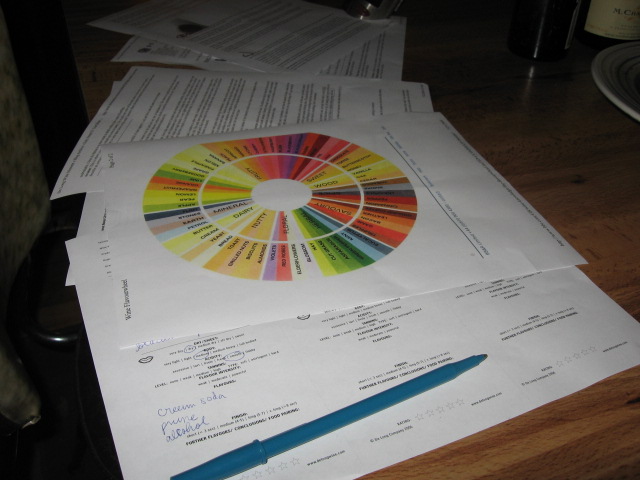
wine tasting notes flavour wheel steve de long wine moment periodic table of wine grape varietiesPapers papers everywhere... I knew that conducting my first formal tasting note would be an idea I'd like to try from the moment it was first suggested back in May by my favourite wine wizard Steve De Long on his site.

Sure, I've “tasted” wine before – I started this blog based on the tasting notes I was taking. (Although lately those notes have been few – summer seems to be having an effect on me.) But I've never really taken tasting notes in a standardized and systematic way. And what I've also never had is a wine education. Not really.

I'm a wine enthusiast not an expert. I grew up around wineries where several members of my immediate family found regular employment. I can remember taking part in educational tastings and tours, celebrating my 21st birthday among vats in the cellar, and more recently attending food and wine matching seminars. I'm keen on it all but it does not an expert make. More practice and discipline are required for that. Focusing on a proper tasting note is a good start for me, or so I thought.

And now this week, weeks after Steve introduced his downloadable tasting note, I finally set out. I was spurred on by the realization that my use of the term "astringence" is anything but expert. I’ve used it incorrectly in several posts over the last year, but I should make that the subject of another piece another time.

So I uncorked the Belleruche rouge for which Steve supplies his notes and went away to work. (He has done notes for various wines and suggests that if you can find the wine he's tasted, it's worthwhile to follow along on his while you complete yours.) The whole thing was a great success. Well, almost the whole thing. Here's how it went:

I would write down my note, then uncover what Steve noted, and then taste again to reconsider. I was pretty much with him all the way (his medium-heavy is what I've been calling medium; I have difficulty timing length of finish, as he says it is tough for anyone unfamiliar with this measurement; I have trouble separating the ideas of "level" and "hardness" of tannins). I even confidently added a flavour note as outlandish as cream soda, which doesn't quite make it onto the official flavour wheel, pehaps because you could parse it down to vanilla plus some combination of berries that approximates grenadine. So yeah, I was really feeling it. I ended up totally enjoying this wine, which I had had many times before, never liking it nearly this much. It was fabulous.

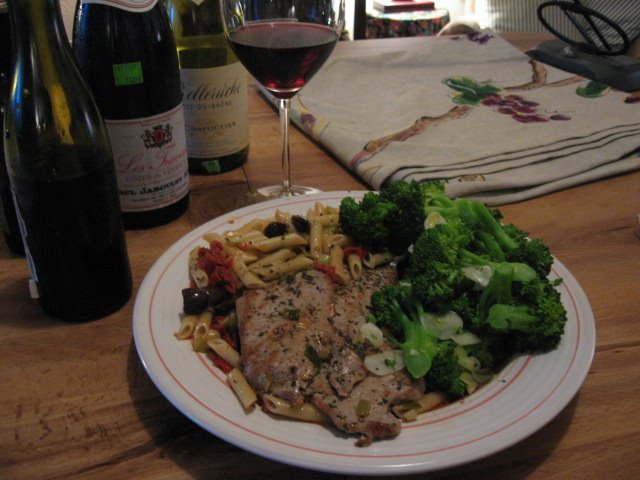
rhone red wine mediterranean dinner pairing veal escalope pasta olives broccoliTasting session complete. Except the part of the form that Steve had left blank: food pairings. I was about to have dinner so I dove right in on this one. But the wine was unwilling. Suddenly its heady level of alcohol came screeching out. It seemed to lose its finesse at the dinner table, though my pairing of intensely flavoured veal, seared with sun-dried tomato and olive pasta was fairly well thought out for the occasion. I tried it again with dinner the next night, but nothing in the wine clicked with food like it did on its own during the tasting. And this was very disheartening but not surprising. I shy away from a lot of Rhône wines precisely because of this. Whether they are too alcoholic or don't have enough acidity to compete with the food I most often make, I can't say.

But what is important to say, and Steve mentions this, is that you got to get food into the tasting process. He says it keeps things on track and centred. I simply say it is the very reason I open up a bottle most nights. So while the experience was an eye-opener, I don't expect to do many more proper tasting notes which start in isolation and then bring on the food if at all. The tasting notes on Weingolb will continue to be rooted in the dining experience, with a focus on food pairings.

20060630

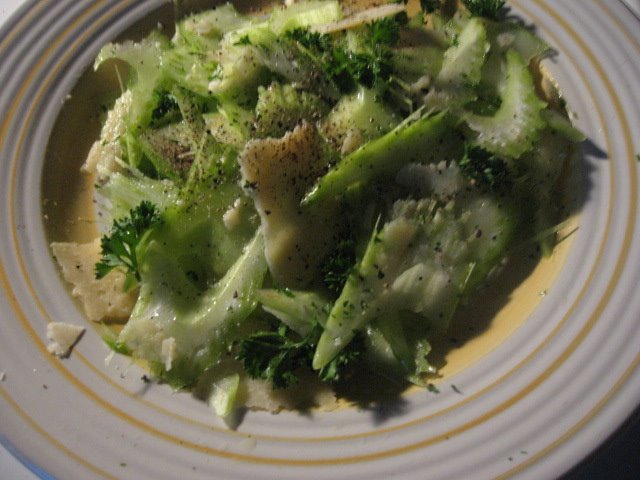
Trout with caper-shallot garnish and potatoes in parsley + Parmesan celery salad

pink trout parsley potatoes jamie oliver celery parmasan salad

or, Pairing fish and other light meals with chilled-down reds

Earlier this week, warm and humid days built up my thirst for a nice light Loire red wine. From my wine rack, I found an Anjou Cabernet. I knew nothing about it except that it possessed the two keywords I was looking for: Loire and Rouge. I remember buying it on sale -- pretty much sight unseen -- for moments exactly like these when I would invariably want a fresh Cabernet Franc to sip alongside a light and summery meal like the air-poached filet of trout and boiled potatoes pictured above.

At the end of a hot day, a chilled aromatic red wine that is low in tannin is great at the dinnertable. It can be the perfect pairing. But my Domaine les Grandes Vignes L'Aubinaie 2003 packed a punch, and it was more than the aromatic wallop that a Loire red often delivers. This one certainly had some body and weight to it.

For sure, the sweltering 2003 vintage could've intensified the consistency of wine, giving it greater depth and brawn, and but this bottle was practically manhandling my demure trout filet. I was surprised that the Parmesan cheese, which I shaved sparingly into my salad because I thought its strong flavour would overpower the wine, ended up being the most natural match for what I was drinking. Why? Sure enough, upon closer inspection, the Cabernet variety listed on the back label was "Franc and/or Sauvignon". It was right there just above where it said "Serve lightly chilled" and then it became obvious.

Even though the recommended serving temperature was 12 to 14 degrees Celsius, this red was no light and merely perfumey expression. It was infused with Cabernet Sauvignon. Sometimes wine more lightweight than this needs chilling to be best appreciated. On this day I was glad to have something cool in my glass, even if the fullness of body didn't demand it. But in the end I think you could avoid the chilling for this wine. And next time I would pour it with steak.

Since I got the wine on a whim and likely will not have the chance to get more, there may not be a next time. It was such an interesting cuvée though, so I jotted down the following information from its many busy labels before I tossed it into the recycling:

  • Domaine les Grandes Vignes is located in Layon in the Loire Valley

  • The estate is family run by the Vaillant brothers: Laurence, Jean-François and Dominique

  • The cuvée L'Aubinaie is certified as organic and earns the Terra Vitis designation

  • Bottled at the Vaillant Estate "La Roche Aubry" Thouarcé, France. 13%.
And last but not least, I realized when a wine pairing sets off your meal in unexpected ways, you can always fall back on the two dishes you prepared to be your perfect food pairing. Man, that trout and celery salad were good and good together!

20060526

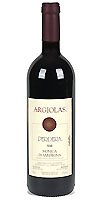
Radical radicchio, add red vino: Argiolas Perdera 2003

Argiolas Perdera Monica di Sardegna 2003radicchio
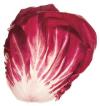
Ever since I ordered the most delicious grilled radicchio dish at Lupa in Greenwich Village back in the summer of 2001 I've been fascinated by this leafy red vegetable.

RADICCHIO -- A FLASHING RED WARNING

First you must know that the bitterness inherent in radicchio is to be revered. Like the bitterest greens -- chicory, escarole, dandelion, etc. -- it can be part of a well-balanced salad, just remember to dress it with a semi-sweet vinaigrette. But radicchio is also among the stiffest, staunchest and hardiest of this bunch. When you combine its stalky, crunchy texture with its naturally strong flavour, radicchio can overwhelm the senses, your meal, and the nice glass of Italian wine you're drinking, which for me at the moment, happens to be Monica, the lovely traditional red grape of Sardinia.

Monica makes fruity varietals, often spiced and of the dusty dried-fruit nature. This Argiolas Perdera Monica di Sardegna 2003 had the most beautiful nose of roses, and reminded me of a Barolo, which was a good sign: surely the strongest of Italian wines would stand up to the grilled radicchio dish that I would try to copy from Lupa chefs Bartoli and Bastianich.

WHY YOU SHOULD PUT RADICCHIO ON A GRILL

Grilling is a great treatment for radicchio. It solves some of the problems that this assertive vegetable can present. Dousing the charred leaves in a balsamic reduction sauce further softens the potent dish, adding richness and some sugar.

When served with tomato and olive pasta, grilled radicchio is a fine match for a rustic Mediterranean red wine, like this one. My Perdera did not have as much structure as I remembered it having in previous vintages, but it is still a great value wine. It carries a light to medium body, and is reminiscent of Zinfandel. Its smokiness and meatiness was nice, if a bit one-note. The wine presented good grip on the finish.

WHICH WINES ARE COMPLEMENTED BY RADICCHIO

So in the end, this wine's length and my handy cast-iron Creuset kitchen grill harnessed the ever-powerful radicchio and rendered it approachable to shy palates. It's no wonder that radicchio is often paired with big flavours like seared steaks and Cabernet Sauvignon.

Serdiana, Italia. 13%

20060519

WBW #21 Fabulous Favorites Festival: Domaine Magellan Ponant 2003

In which Eric and I join forces to produce a post on this month's Wine Blogging Wednesday theme: take a favourite bottle of wine and create a meal around it.
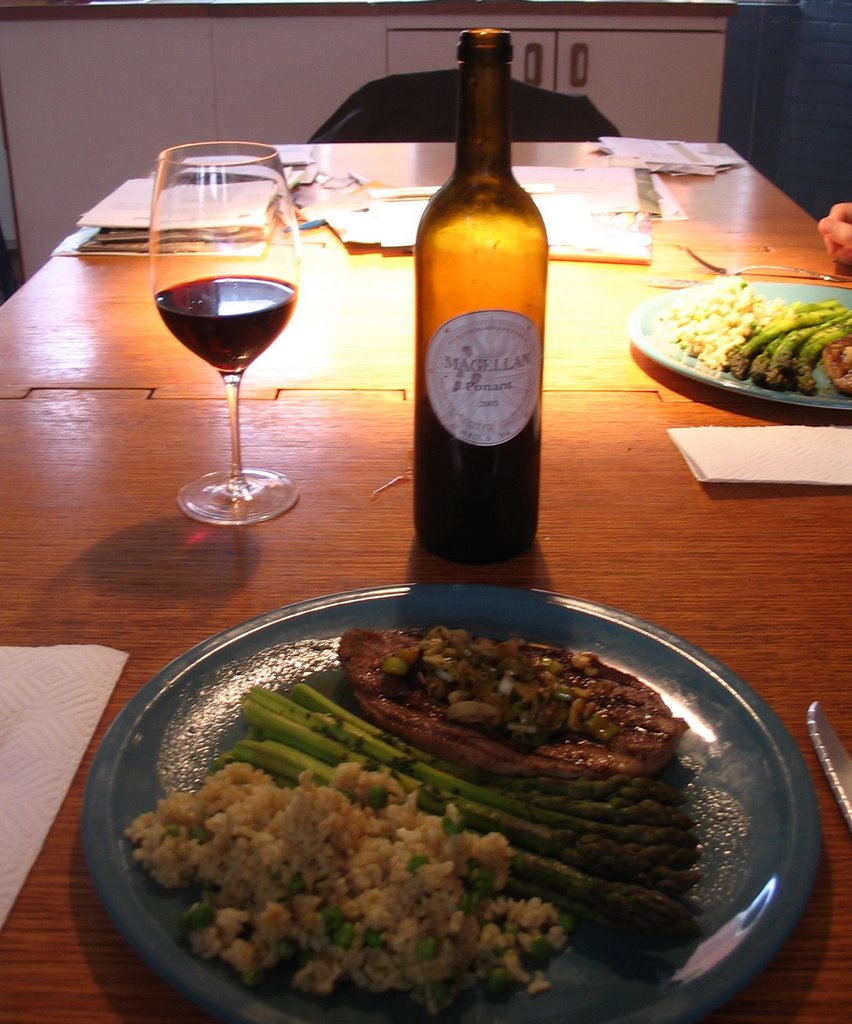
Domaine Magellan Ponant 2003 Vin de pays des Côtes de Thongue lamb dinner pairing
Alliances can be fantastic things. I'm thinking of WWI, WWII, WBW, and the list goes on. So on this occasion when Wine Blogging Wednesday joins Is My Blog Burning? for a great food and wine installment (thanks to WBW Lenn and Il Forno's Alberto, who are both hosting this joint effort), it seems suitable that my friend Eric and I pair up for an entry to today's event.

And so it began with a bottle of my favourite wine. At 6:30 pm, with bread and wine in hand, I descended upon Eric's kitchen, which was spacious and well-equipped -- as always -- but also stocked with the key components of our meal, courtesy of Eric.

I would do the cooking and plating here. Eric would assume clean-up duties. I would write the notes; he would send me the photos he took. We would both get to eat and drink. It was an advantageous alliance. But the real synergy started when I asked Eric if he could help with the prep.

doktor weingolb cooks up fabulous favourites tom littledeer wooden kitchen utensilsI was chopping green onion for garnish when Eric suddenly started peeling the stalks on the home-grown Quebec asparagus he found, which are currently in season. The peeling idea came from an email I had sent him earlier in the day when we were discussing what we would do for dinner. I emailed it as a bit of a joke because for years we have been enjoying thick, meaty and delicious asparagus with all its skin fully intact. Nevertheless Eric was inspired to peel and he soon uncovered a chartreuse layer of the asparagus. It offset the dark green flecks of tarragon in the sauce I made. This was an interesting development. Our vegetable would now be a beautiful two-toned green. But I knew that this nice visual effect would just be a bonus...

KEY INGREDIENTS

Asparagus with tarragon is a wonderful combination any day. On this night, it was also a complement to the anisé tones of our wine, a typically spicy Syrah-based blend from the south of France. The idea was to have this Domaine Magellan Ponant 2003 Vin de pays des Côtes de Thongueecho the light licorice flavours of the dish.

Since Ponant is a vin de pays, it can, unlike its many of its Midi neighbours with an AOC designation, add some Cabernet to its Syrah. Personally I love the Cab-Syrah combo and could drink it all on its own. But for our dinner's sake, this kind of blend was signaling some serious red meat.

Lamb is ideal. (Says Eric: Quebec lamb is even more ideal -- and not just because it goes with the Quebec asparagus. Locally bred and grown produce is really important to Eric, who has been reading The Omnivore's Dilemma by Michael Pollan.) quebec lamb cutlets tarragon asparagus long grain rice with peasRich and deeply flavoured, a grilled lamb steak cut from the gigot has an affinity with the darker notes of this Syrah-Cabernet Sauvignon-Merlot blend: blackened fruits, cedar, earth.

PREPARATION METHOD

Grilled to achieve a wee bit of carbon, the steaks would complement the tobacco finish of the wine. But before the main dish is done, we add garlic, olive oil and savory -- naturals in a pairing that focuses on depth of flavour. For balance, rice makes an appearance at the table. Dotted with green peas, perfectly cooked brown rice emerged from Eric's smart rice-cooker, which is resembles a plastic pig. Oink oink. Dig in.

UN PETIT DESSERT

Eric also picked up dessert from our favourite little neighbourhood bakery in all of Montreal, Boulangerie Les Co'Pains d'Abord, and it was deep and rich too. Keep some vino in your glass for this Far Breton, an eggy but firmly textured treat, filled with oozing and deliciously overripened prunes. I wish we had remembered to take photos, but this little fruit flan was so good and matched so wonderfully our final drops of wine, no such thought went out.

And there you have it. I grilled, blanched and served. Eric planned, shopped, and bussed. By 7.45 pm, we were all done. Our alliance was as a perfect as a classic food and wine pairing, as symbiotic as the legendary convergence of WBW and IMBB.

20060508

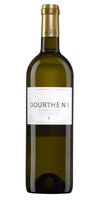
Acid test: Matching seafood and Sauvignon (Dourthe No. 1 2004)

Dourthe No. 1 2004
White wine often makes a nice apertif. Sauvignon Blanc is no exception. In fact it is the perfect before-dinner drink. Zippy and refreshing, this grape does a good job at waking up your tastebuds and getting them ready for meal that lies ahead.

There is a reason for this. Sauvignon Blanc can pack dangerous astringency -- both in the form of citrus flavours and heightened levels of acidity. It is the kind of combination that can often grind to a halt the enjoyment of creamy and rich courses. (You'll be disappointed if you blindly pair this wine with fish -- a salmon-based rosé sauce on pasta, for example is a screamingly bad partner for most Sauvignon. I know because I tried it.)

WINE AND FOOD RATIONALIZATION

That does not mean that Sauvignon Blanc should be removed from food settings. There are so many great matches for it. You are just advised not to match it with your creamier dishes. Cheese can work and work well, especially cheese on a pizza. The tomato sauce will complement the acidity in the wine. I recommend a seafood pizza in particular. The crab-meat, shrimp and scallops will make your meal sing.

And here is the song: Dourthe No. 1 2004. From Bordeaux, this wine falls under the general Bordelais appellation (AOC). This means it's a good value (click on the bottle image for retail information).

NO-RISK DRINKING

Vignobles Dourthe has always been a reliable bargain-priced producer of international grape varieties. This 2004 vintage, which for the first time is indicated as a Sauvignon Blanc varietal on the front label, is no different.

The 2004 Dourthe No. 1 is a pale golden colour. On the nose, hints of brioche and yeast emerge while luscious white fruit and a touch of spice are clean and crisp on the palate. There's a slightly racy edge to it but everything remains well-balanced. Its bracing mouthfeel is replete with starfruit banana-like fruit notes. It's got a bit of toast to and a nice even finish.

Parempuyre, France. 12%

Backwash
Blogger's been a bad boy.

Last time it was my own boring drivel that prevented a timely update. This time it was a Monday post turned into a Tuesday-at-two, I'm-at-work-but-now-that-I've-finally-got-a-blogspot-window-I'd-better-upload-on-company-time. Zut alors!